
How much does a business valuation cost in France, and what do you get?
The online report took four minutes and cost 299 EUR. The owner of an industrial maintenance company in Mérignac, 3 M EUR of revenue and 24 staff, typed in last year’s figures on a Sunday evening and read the result: 1.55 M EUR. He plans to sell in two years, at 63, and that number has stayed in his head since.
In France, a business valuation costs from about 130 EUR for an automated online report to 2-8 K EUR for a multi-method report on a small company, and more for a transaction-grade valuation (published prices, November 2026). The right choice depends on what the number is for: a first order of magnitude, a tax or legal file, or a negotiation. For a sale, the report you paid 299 EUR for is a sensible first step. It is the wrong one to negotiate with.
Preparing a sale, a partner exit or a fundraising?
We value your company with the restatements listed one by one, both methods side by side, and the model handed over to you.
Book a valuation callWhat are you actually paying for in a valuation?
You pay for four things: the methods, the restatement of the accounts, judgement on the assumptions, and someone accountable for the number. The cheaper the report, the more of the last three you do yourself, often without knowing it.
The methods are the visible part and the least expensive one. Applying a sector multiple to an EBITDA figure takes software a few seconds. A discounted cash flow (DCF) takes longer, but the arithmetic is standard. What costs time is the input. Every method starts from a profit figure, and the reported figure of a small company is rarely the one a buyer will pay for.
That is what restatements fix. The owner’s own pay may sit below or above what a hired manager would cost. The company may rent its premises from the owner’s property company at a friendly rent. A lawsuit, a one-off subsidy or an exceptional contract may have moved last year’s result. A buyer restates all of this in due diligence, and every euro of EBITDA removed costs several euros of price, because the price is a multiple of it.
Judgement is the third layer: which multiple, given the company’s size, its customer concentration, its order book and how much of the business depends on the owner. Accountability is the last: a named person who can explain each line of the number to a buyer, a banker or a tax inspector, and who is still there when the buyer’s adviser challenges it.
What does each type of valuation cost in France?
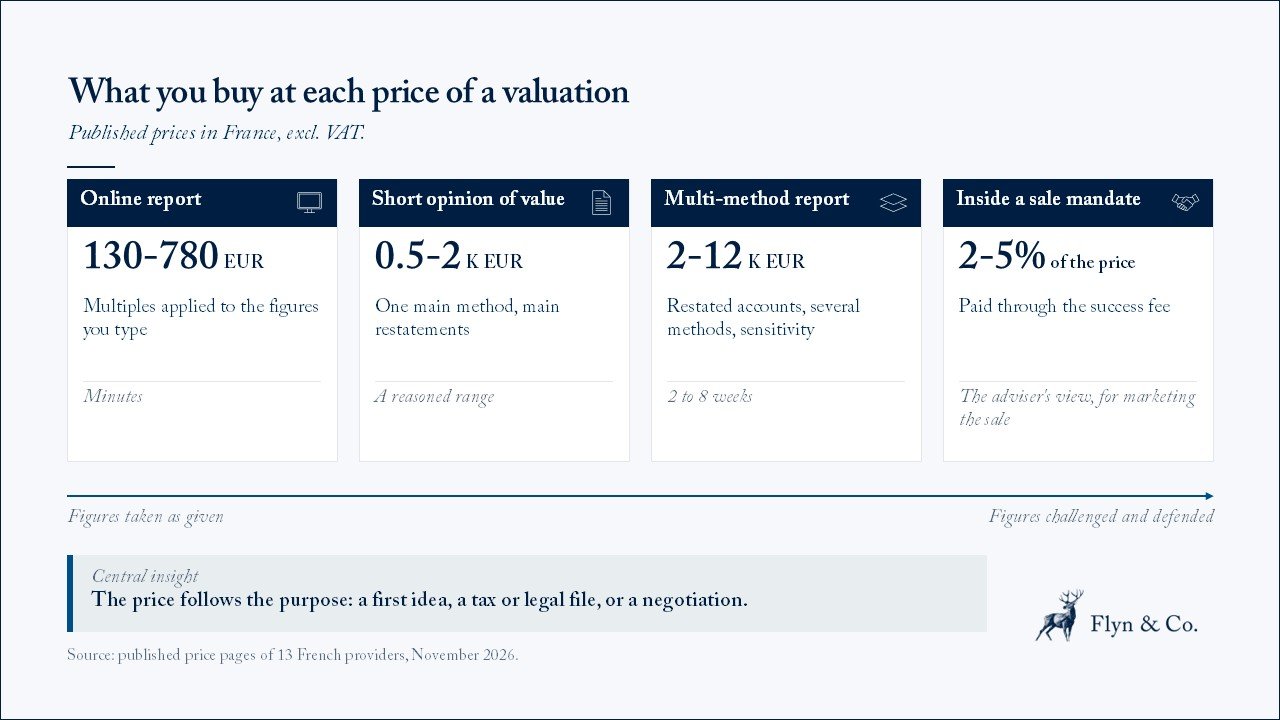
Four levels cover most of what a small company owner will find. The prices below are those published by French providers on their own pages, excluding VAT, read on November 2026.
| Type of valuation | Published price (excl. VAT) | What you get | When it fits |
|---|---|---|---|
| Automated online report | 129 to 780 EUR (startups: 291 to 742 EUR) | Sector multiples, sometimes a simplified DCF, applied to the figures you type in; the top of the range adds a one-hour call | A first order of magnitude, before deciding anything |
| Short opinion of value (avis de valeur) | 0.5 to 2 K EUR, from 800 EUR at a chartered accountant | One main method, the main restatements, a reasoned range in a few pages | An internal decision: a partner discussion, a first talk with a bank |
| Multi-method report (chartered accountant or independent valuation firm) | 2 to 12 K EUR for small companies, by revenue; up to 30 K EUR for larger or complex ones | Restated accounts, several cross-checked methods, sensitivity tests, a written report; delivered in 2 to 8 weeks | A sale or acquisition being prepared, a fundraising, a partner exit, and, when certified, a tax or legal file |
| Valuation inside a sale mandate | No separate invoice: paid through a success fee of 2-5% of the sale price, sometimes with fixed fees | The adviser’s view of the price to ask, used to market the company | Once the decision to sell is taken and an adviser is mandated |
Two prices sit outside the table. Software for professionals runs on subscriptions (about 99 EUR a month for unlimited estimates), which is how some advisers produce their first figure. And the full sale support that follows a valuation is priced separately: published retainers run from about 10 K EUR, and one sale-cost guide gives intermediary fees of 3-9% of the price on small deals, the rate falling as the deal grows.
The spread inside the multi-method level comes from the company’s size and the purpose. Grids published by small-company specialists start at about 2 K EUR under 500 K EUR of revenue and reach 6-12 K EUR for a service company with 2-5 M EUR of revenue.
What does the online report miss for a company like this?
The 1.55 M EUR in Mérignac came from three typed figures: EBITDA of 330 K EUR, a sector multiple of 5.0 times chosen by the tool, and net debt of 100 K EUR. The arithmetic is right. The inputs are the ones a buyer will change.
| Restatement | Effect on EBITDA | Why a buyer makes it |
|---|---|---|
| Owner’s pay at 60 K EUR, a hired manager at 110 K EUR | -50 K EUR | The buyer will have to pay someone to run the company |
| Premises rented from the owner’s property company, 30 K EUR a year below market | -30 K EUR | The lease will be reset at market rent after the sale |
| Settlement of a dispute with a former customer in 2025 | +30 K EUR | It will not happen again |
| Restated EBITDA | 280 K EUR |
Then the multiple. The largest customer, an aerospace subcontractor, brings 35% of revenue. A buyer will see that and price it, through a lower multiple or an earn-out tied to the contract’s renewal. At 4.5 to 5.0 times restated EBITDA, the enterprise value lands at 1.26-1.40 M EUR, and the equity value at 1.16-1.30 M EUR after net debt.
The gap with the number in his head is 250-390 K EUR. Each 10 K EUR of EBITDA is worth 45-50 K EUR of price at these multiples, which is why restatements matter more than the choice of method.
None of this makes the online report wrong. It answered the question it was asked, with the figures it was given. The owner learnt something useful for 299 EUR: the order of magnitude, and that a sale was worth preparing. What it could not tell him is what a buyer’s adviser will find in the accounts, and he would rather find it himself two years before the sale than in the buyer’s due diligence report.
Which valuation do you need for a sale, a fundraising, a tax file or a partner exit?
The purpose decides, and it decides more than the budget.
For a tax or legal file, the choice is narrow. A donation of shares, a Dutreil pact, a dispute between partners or a court case calls for a valuation signed by a chartered accountant, a court-registered expert or another professional whose report the tax office or the judge will accept. Price it as a separate engagement. An indicative valuation, from any adviser, does not replace it.
For a first idea, before any decision, an online report or a short opinion of value is enough. Use it to decide whether a sale is worth preparing at all, and keep the printout away from the negotiation.
For a sale, a buyer conversation, a fundraising or a partner exit settled by agreement, you need a valuation you understand and can defend. That means restated accounts, at least two methods, a sensitivity table showing which assumptions move the value most, and, ideally, the model behind the report, so that you can rerun it when the buyer changes an assumption. In a fundraising the same logic applies, with the investor’s methods (comparable rounds, a revenue multiple for a startup, the dilution the round implies) in place of the buyer’s.
In Mérignac, the useful sequence is a multi-method valuation now, at the 4.5-8 K EUR level the published grids give for a company of this size, while there is time to act on what it shows: reset the lease at market rent, document how the business runs without the owner, start winning customers that dilute the aerospace contract. Then an update in 18 months, when the adviser who will run the sale is chosen and the mandate’s own valuation can be compared with one the owner already understands.
Why a serious valuation uses both a DCF and multiples
Multiples say what the market pays for similar companies. A DCF says what this company’s own cash flows support. The gap between the two is where the negotiation happens.
Multiples are quick and familiar to buyers. Their weakness is that a “similar” company is rarely similar: transaction multiples for small French companies are sparse, depend on the sector and the year, and say nothing about this company’s order book or its customer concentration. A DCF has the opposite profile. It is built on the company’s own forecast, so it shows exactly which assumption carries the value (a growth rate, a margin, the capital spending a maintenance business needs to keep its vans and tools running), but every one of those assumptions can be challenged.
The first thing I check in any valuation is whether the two methods tell the same story. If the DCF gives 1.6 M EUR and the multiples give 1.2 M EUR, one of the forecasts is too optimistic or the multiple is wrong for this company, and the report should say which. A valuation that shows only one method, or shows two without explaining their gap, leaves the owner without an answer when the buyer picks the lower one.
What makes a valuation cost more?
Six things move the price of a valuation, and you can influence most of them before asking for a quote.
The number of entities comes first: a holding company with two operating subsidiaries and a property company is three sets of accounts to restate and consolidate. The quality of the accounts follows. Monthly management figures, a clean split of revenue by customer and a reconciled balance sheet shorten the work by days. Then the restatements themselves, the sector data needed for comparables, the purpose (a transaction needs more depth and more defence than an internal decision), and whether you receive the financial model or only the report.
Ask every provider the same questions before signing: which methods will be used, whether the restatements are listed one by one, whether a sensitivity table is included, whether the model is delivered, how many meetings are planned to discuss the result, and whether the report is certified. Two quotes at 3 K EUR and 6 K EUR are often two different products.
Questions owners ask about the cost of a valuation
Is a free online valuation reliable?
It is a useful first order of magnitude, built on the figures you type in. It cannot know what those figures hide: a below-market rent, an owner paid half a manager’s salary, a one-off gain. Free versions usually give an on-screen range; paid reports from 129 EUR add a document and sometimes a call.
Does a valuation need to be certified?
Only for tax, legal or dispute purposes, where the tax office, a judge or the other party must accept the report. For a sale or a fundraising between willing parties, what matters is that you can explain and defend each line of the number. Flyn & Co.’s valuations are indicative and are never certified.
How long does a valuation take?
Minutes for an automated report. Published delivery times for full valuations run from a few days for an analyst-reviewed report to 2-8 weeks for a multi-method report, depending on the company and on how quickly the accounts and management figures arrive.
Is the M&A adviser’s valuation free?
It is part of the mandate and paid through the success fee, usually 2-5% of the sale price, sometimes with fixed fees on top. It is also the view of someone paid when the sale closes. An independent valuation before signing the mandate is a separate choice, and it helps you judge the price the adviser proposes to ask.
How much does a startup valuation cost?
From about 290 EUR for an online tool with an exportable report to 2-8 K EUR for an adviser’s valuation of a seed or pre-series A company with one share class. Before a round, the valuation matters less than the dilution it implies and the milestones the money must reach.
Two years before the sale
The owner in Mérignac paid 299 EUR for a number that was 250-390 K EUR too high. A multi-method valuation now costs him about 2% of that gap, and it gives him two years to close part of it with the lease, the customer mix and the way the company runs without him. That trade is the reason to pay for a valuation before you need one.
Other French firms invoice a full valuation between 2 K and 30 K EUR excl. VAT, and what the client receives at that price varies widely. We work the same way at every size: the restatements listed one by one, both methods explained side by side, the model handed over so you can rerun it when the buyer changes an assumption, and Francisco Silva leading the work personally. If you are preparing a sale, a partner exit or a fundraising, here is how we value a company with you.
Sources
- Published price pages of 13 French valuation providers (online valuation tools, chartered accountants, independent valuation firms and M&A advisers), with prices from 129 EUR to 30 K EUR excluding VAT, read on November 2026.
- Two French guides on the cost of selling a company, published by sale advisers in 2026 (intermediary fees of 3-9% of the price, retainers from about 10 K EUR), read on 25 November 2026.
One final word : Stay tuned for more insights on Finance, Investing, Real Estate & Startups.
More posts...
FP&A and Cash Forecasting: How Much Can Your Business Afford to Commit?
A business can finish the quarter with enough cash and still face a liquidity constraint along the way. Learn how FP&A connects cash forecasts, growth commitments and the deadline for management action.
Airbnb, Booking and Expedia: Who Captures the Value of Travel?
Airbnb, Booking and Expedia: Who Captures the Value of Travel? How travel platforms turn demand into revenue – and what their economics mean for hospitality
Preparing a Board for a Difficult Quarter
How to explain a performance miss and secure decisions while the business still has room to act.
SaaS Financial Planning: How to Turn ARR Growth Into Cash and Enterprise Value
SaaS Financial Planning: How to Turn ARR Growth Into Cash and Enterprise Value ARR growth tells you whether a SaaS company is getting bigger. It
Budget 2027: Build a Plan Your Business Can Actually Use
The strongest budgets make assumptions explicit, quantify the cash impact and define how management will respond.
Why Bordeaux Wine Estates Need a 24-Month Cash Model
Why Bordeaux Wine Estates Need a 24-Month Cash Model Bordeaux’s wine industry is adjusting to lower volumes, shifting consumption, weaker exports and structural vineyard contraction.