
Preparing a Board for a Difficult Quarter
How to explain a performance miss and secure decisions while the business still has room to act
A difficult quarter usually becomes visible before the accounts are closed. Orders slip. Customers take longer to pay. Gross margin weakens while the cost base continues to reflect a more optimistic plan.
Management then faces two deadlines: the Board meeting and the last date on which a useful corrective action can still take effect. Those dates rarely coincide.
Preparing the Board starts with making that gap visible. Directors need a credible explanation of the deterioration, a revised view of the business and recommendations they can challenge. They also need to know how long each option remains available.
For founders and CFOs, the strongest approach is to connect the performance miss to cash, execution lead times and explicit decisions. A polished presentation cannot compensate for an outlook that still depends on assumptions management no longer believes.
The approach below is designed for SMEs and growing companies with an active Board or Investor Committee. It focuses on management preparation and financial decisions rather than a universal reporting template.
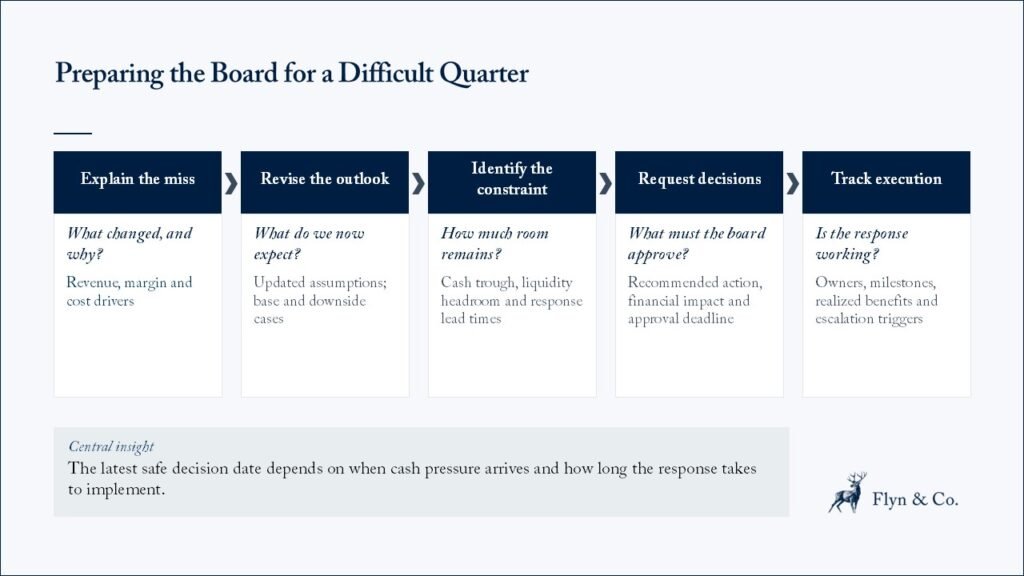
Warn the board when the outlook changes
Once a material deterioration becomes credible, agree with the chair how to inform the board promptly. Waiting for the reporting cycle can leave directors learning about a problem after the available responses have narrowed.
The initial update can be short. State what has changed, what is confirmed, which estimates remain provisional and when management will provide a fuller assessment. If the numbers are still being reconciled, identify the uncertainty specifically. A missing customer acceptance certificate is different from a general claim that finance needs more time.
- The Financial Reporting Council’s Corporate Governance Code Guidance emphasises timely, accurate and clear information, together with adequate time for Board discussion. These are useful preparation principles beyond the UK companies to which the Code applies. [1]
- Discuss the agenda with the chair. A quarter dominated by a funding constraint may require more time on liquidity and financing than on routine departmental updates. The board should receive the evidence needed to test management’s recommendation before the meeting, with subsequent changes clearly identified.
- Prepare the CEO and CFO together. They should agree on the facts, the revised outlook and the decisions being requested. Genuine uncertainty should remain visible. If sales expects a delayed contract to return next quarter while finance sees insufficient evidence, show the assumption and the evidence needed to resolve it.
That disagreement may be the most important information in the pack.
Diagnose the miss and revise the assumptions
- “Revenue was below expectations” identifies the result. It leaves the board without a diagnosis.
- Explain the movement through operating drivers. Separate lower volumes, price changes, customer or product mix, delivery delays and cost movements. Show actual or provisional performance against the budget, the previous forecast and the comparable prior-year period. Each comparison answers a different question: ambition, recent judgement and underlying trajectory. A monthly reporting pack provides the recurring foundation for these comparisons.
- A recurring problem is classifying lost revenue as delayed revenue. A customer postponement supports a timing explanation only when there is evidence of a revised delivery date, continuing demand and sufficient capacity to fulfil the order. Otherwise, recovery belongs in a conditional scenario.
Consider a hypothetical business with the quarterly outlook below. All figures are illustrative and use a consistent EBITDA definition; they are not Flyn & Co. client results.
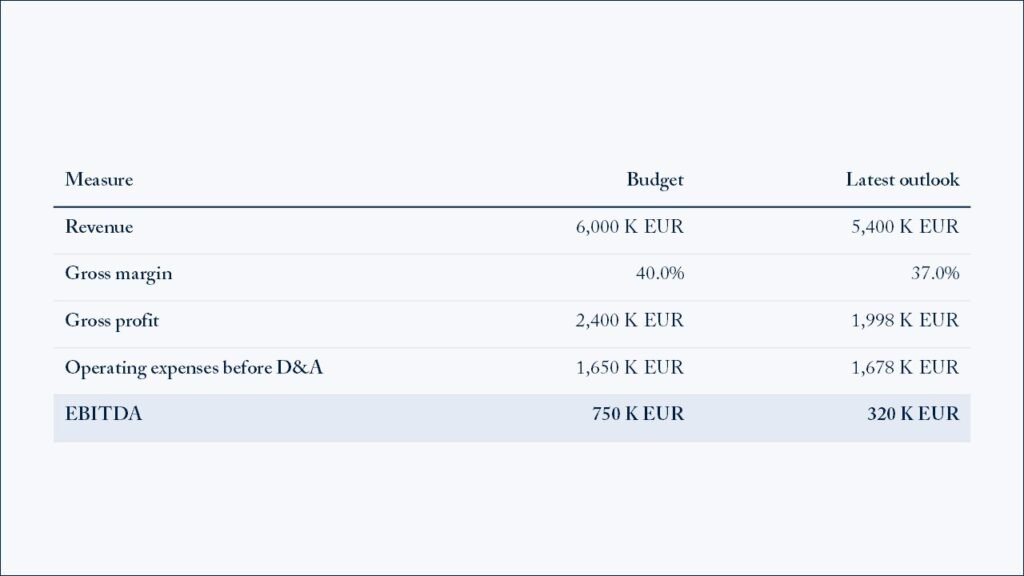
Revenue falls by -10%, but EBITDA falls by approximately 57%. The bridge is straightforward: 240 K EUR lost gross profit from lower revenue at the budget margin; 162 K EUR from the lower margin rate applied to revised revenue; and 28 K EUR from higher operating expenses.
The Board now has distinct questions to examine. Can demand recover? Is margin pressure temporary or persistent? How quickly can the cost base respond? Cutting discretionary expenditure alone may leave the larger commercial problem unresolved.
Keep the original budget visible, then replace outdated forecast assumptions. Show which assumptions changed, who owns them and what evidence supports the revision. If the previous forecast missed the deterioration, explain the forecasting weakness and the correction. That might mean using actual collection behaviour, revising pipeline conversion or integrating operational delays earlier.
The IASB’s revised Management Commentary Practice Statement, issued in June 2025, promotes more focused narrative reporting and connected information across financial reports. Applied here as a reporting principle, the explanation of the quarter should agree with the numbers and revised assumptions. [2]
Show the cash constraint and when it arrives
An EBITDA miss becomes more consequential when receivables rise, inventory accumulates or debt payments approach. Show how the operating outlook translates into cash, including working capital, tax, interest, capital expenditure and debt principal.
For short-term liquidity pressure, use a rolling weekly forecast over the next 13 weeks alongside a longer monthly view. Reconcile opening cash to bank balances and identify restricted amounts. Show committed funding separately, including conditions that could limit access. Prospective financing should remain outside available liquidity until it is secured and accessible.
Our article on cash flow forecasting for small businesses explains the timing discipline behind this view. For a difficult board discussion, bring attention to the lowest cash point, the relevant thresholds and the time required to respond.
Extend the hypothetical example. Unrestricted quarter-end cash is 1.1 M EUR. Over the following 13 weeks, the forecast cash trough is 650 K EUR in the base case and 250 K EUR in a credible downside case. Management proposes a minimum operating cash buffer of 600 K EUR to cover near-term payment needs and uncertainty.
The base case therefore leaves only 50 K EUR above the operating buffer. The downside creates a 350 K EUR gap. The board needs to examine the assumptions producing that difference, especially collections, payroll and committed expenditure.
An operating cash buffer and a contractual debt covenant are separate constraints. Report each on its own basis. If a covenant is relevant, show the calculation under the financing agreement, the testing date and sensitivity to weaker performance.
Calculate the latest safe decision date
The next step is to calculate the latest safe decision date. In the example, downside cash first falls below the operating buffer in week eight. A proposed response needs four weeks to implement, and management allows one additional week for slippage. The latest safe approval point is therefore week three.
That date belongs beside the recommendation. Waiting for certainty can consume the time needed to execute.
Need a clearer financial view before your next board meeting?
Flyn & Co. helps management connect P&L Forecasts, Cash flow and financial performance reporting to practical decisions. Discuss a focused Finance Visibility Sprint to clarify the outlook, liquidity risks and priority actions.
Test the downside before adding recovery actions
Build a base case from current evidence and a downside case from specific risks. Then show the effect of proposed actions separately. This helps directors distinguish the underlying exposure from the benefits management hopes to achieve.
Simply reducing every revenue line by the same percentage can conceal the risk. A concentrated customer default, a slower sales cycle or higher delivery costs creates a different cash pattern. Include linked effects when justified: weaker demand may leave excess stock, while discounting may support sales but reduce margin.
In the illustrative downside, management considers deferring 300 K EUR of capital expenditure and accelerating 150 K EUR of existing customer receipts. Assume both cash effects occur before the first buffer breach and remain available through the forecast trough.
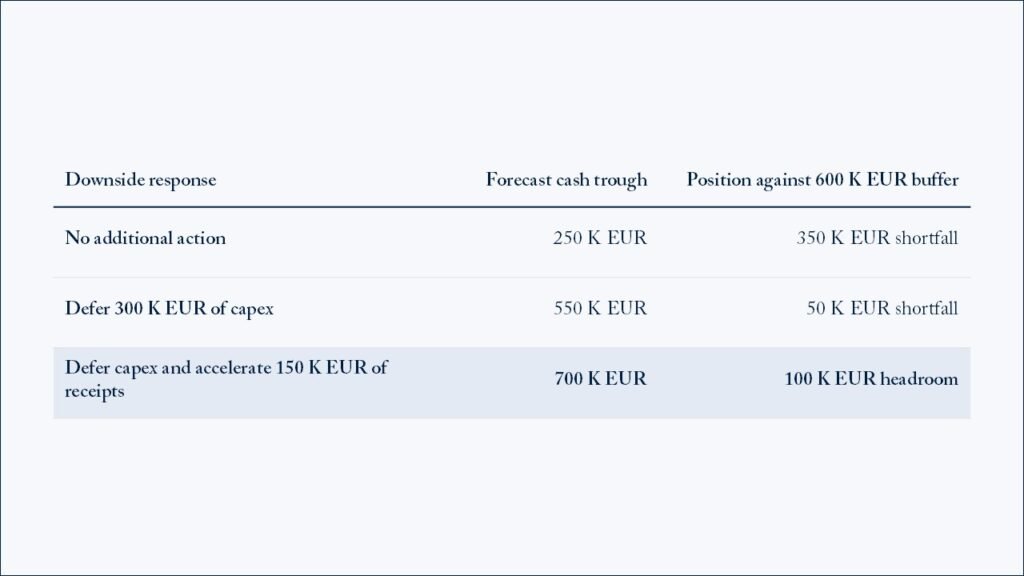
These are conditional cash outcomes. The collection benefit requires customer agreement and execution; it should remain labelled as unconfirmed until supported. Deferring capex also moves expenditure beyond the forecast horizon, so the longer-term model must show the later payment and any operating consequences.
Neither action automatically repairs EBITDA. Accelerating receipts changes timing, while deferring investment preserves short-term cash. If profitability remains weak, the board still needs to address pricing, mix, capacity or the cost structure.
Compare response options and execution risks
Compare alternatives on their consequences as well as their immediate cash benefit. Protecting cash by cancelling essential maintenance could increase disruption risk. A broad hiring freeze could constrain delivery on profitable, contracted work. Reducing unprofitable activity may be more effective than spreading cuts evenly across the organisation.
Separate actions already authorised and embedded in the forecast from proposals awaiting approval. Account for execution costs, lead times and dependencies. Avoid counting the same invoice collection twice under both a working capital initiative and a cash recovery programme.
Ask for decisions with limits and owners
A recommendation such as “approve the recovery plan” leaves too much unresolved. Specify the decision, the amount involved, the implementation owner, the deadline and the conditions that would change the recommendation.
In the example, Management could request approval to defer the identified 300 K EUR investment, subject to operations confirming that the delay will not compromise existing delivery commitments. It could also propose immediate customer discussions on the 150 K EUR receipts, with a defined escalation if agreement is not obtained.
The residual exposure deserves a separate decision. Capex deferral alone leaves a 50 K EUR gap to the operating buffer. The board should understand which additional measure will cover it if collections do not accelerate, how long that measure takes and who can authorise it.
Set authority according to the company’s governance arrangements. Management should execute within existing delegations, while reserved matters receive the required approval. The chair, directors and finance team need a shared understanding of which changes trigger renewed board consideration.
Set measurable triggers for renewed Board action
Use a few measurable triggers tied to the actual risk. Examples include a named customer missing an agreed payment date, forecast cash dropping below the operating buffer or a material contract moving outside the delivery window. Define the owner and response when each trigger occurs.
The bBard can then challenge the recommendation, approve it conditionally or choose an alternative with a clear understanding of the consequences.
Make the next update test management judgement
Open the meeting with the changed outlook, its principal causes and the decisions required. Explain the financial constraints early enough for directors to use them when discussing strategy and execution.
Be ready for the difficult questions. Why did management identify the miss only now? Which recovery assumptions have independent support? What happens if the largest customer pays late? Which spending decisions become costly to reverse? Where did the previous reporting process fail?
If an answer is unknown, record the question, name an owner and give a date for the evidence. Close the meeting with a clear decision record, including conditions, delegated authority and follow-up dates.
During liquidity pressure, management should review the weekly forecast and compare actual receipts and payments with the previous version. Agree a proportionate board update cadence and escalate material trigger events promptly. Track action benefits against the amounts presented, alongside any unintended commercial effects.
A weaker quarter may require management to accept a lower profit outlook, slow investment or abandon an unprofitable growth assumption. The Board needs the evidence and time to make those choices while they are still available.
The preparation is successful when directors can identify the exposure, understand management’s recommendation and see the date by which action must begin. That is the standard the next update should test.
Sources
[1] Financial Reporting Council — Corporate Governance Code Guidance. Used for the principles of timely, accurate and clear board information and sufficient discussion time.
[2] IFRS Foundation — IASB issues revised Practice Statement on management commentary, 23 June 2025. Used for focused narrative reporting and connected information.
The numerical example, cash buffer and timing framework are illustrative Flyn & Co. analysis. Neither reference prescribes this board pack, its cash threshold or its implementation timetable.
More posts...
SaaS Financial Planning: How to Turn ARR Growth Into Cash and Enterprise Value
SaaS Financial Planning: How to Turn ARR Growth Into Cash and Enterprise Value ARR growth tells you whether a SaaS company is getting bigger. It
Budget 2027: Build a Plan Your Business Can Actually Use
The strongest budgets make assumptions explicit, quantify the cash impact and define how management will respond.
Why Bordeaux Wine Estates Need a 24-Month Cash Model
Why Bordeaux Wine Estates Need a 24-Month Cash Model Bordeaux’s wine industry is adjusting to lower volumes, shifting consumption, weaker exports and structural vineyard contraction.
Fractional CFO vs. Full-time CFO: Which One Should an SME Choose?
Fractional CFO or full-time CFO? Learn which option makes more sense for SMEs, growing businesses, and founder-led companies that need financial leadership without overbuilding the finance function.
Bordeaux Neighborhoods for Property Investment: Which Signals Matter Most?
Learn how to assess Bordeaux neighborhoods for property investment using four key signals:
tenant demand, entry basis, capex risk, and exit depth. A practical framework for smarter real estate
decisions.
When Revenue Growth Becomes Dangerous: The Cash Flow Side of Scaling Too Fast
In small businesses, growth can consume cash faster than it creates it. The danger is not growth itself, but growth that stretches working capital, weakens margins, increases fixed costs, and hides liquidity risk behind a positive sales story.