
How to think about key Bordeaux neighborhood profiles
The point is not to declare one winner.
The point is to understand the investment logic behind different neighborhood profiles. In Bordeaux, several districts can be attractive, but they are attractive for different reasons — and under different underwriting assumptions.
A strong neighborhood does not automatically mean a strong deal. The investment case still depends on entry price, capex exposure, tenant demand, and exit depth.
Chartrons and Jardin Public
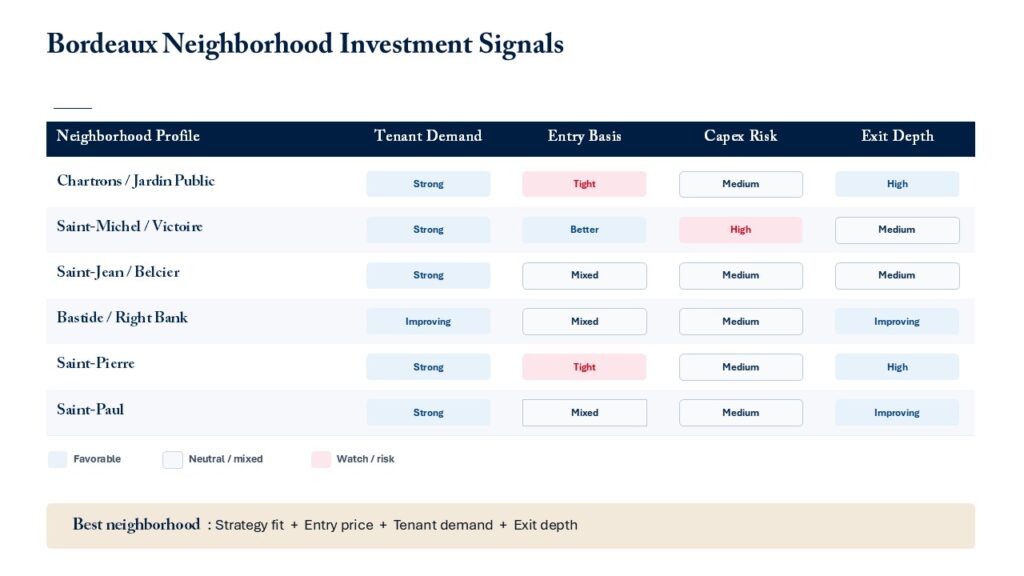
Chartrons and Jardin Public remain among the strongest Bordeaux profiles for tenant demand and exit liquidity. They benefit from centrality, lifestyle appeal, architectural quality, and a broad buyer pool.
For investors, the main issue is not demand. It is basis.
Entry prices are often tight, which means the investment case usually needs to be justified by asset quality, long-term resilience, premium positioning, and resale depth rather than by high rental yield alone.
These areas can work well for investors prioritising capital preservation, quality furnished rentals, or future owner-occupier exit optionality. But they are less forgiving if the acquisition price is too high or if renovation costs are underestimated.
Best suited for:
- Premium long-term holds
- High-quality furnished rentals
- Resilient resale strategies
- Capital preservation logic
Main risks:
- Tight entry basis
- Compressed yield
- Renovation costs in older buildings
- Overpaying for reputation
Saint-Pierre
Saint-Pierre is one of the strongest central profiles in Bordeaux from a demand and exit perspective.
It benefits from historical centrality, strong lifestyle appeal, walkability, and a broad pool of potential tenants and buyers. For furnished rentals, medium-term stays, or long-term central living, demand can be strong when the asset is well positioned.
But like Chartrons or Jardin Public, the main constraint is usually the entry basis.
Saint-Pierre is not a district where investors should expect easy bargains. The investment case needs to be built around quality, liquidity, and durable demand — not only gross yield.
The main diligence point is to avoid confusing central appeal with automatic value creation. Street quality, building condition, noise exposure, floor level, layout, and copropriété risk can materially change the outcome.
Best suited for:
- Central furnished rentals
- Medium-term professional demand
- Premium smaller apartments
- Resale-oriented strategies
Main risks:
- Tight entry price
- Noise and street-level variability
- Older building capex
- Yield compression
Saint-Michel and Victoire
Saint-Michel and Victoire offer a different investment profile.
Tenant demand is strong, especially for students, young professionals, central living, and furnished rental strategies. Entry basis can be more attractive than in the most premium central areas, which can create better yield potential.
However, the capex risk is higher.
This is where asset selection becomes decisive. The difference between a strong and weak investment may come down to the specific street, building condition, common areas, layout, sound exposure, humidity, and renovation needs.
These districts can work well when the investor has a clear operating strategy and enough capex discipline. They are less suitable for passive investors relying only on centrality and headline rent assumptions.
Best suited for:
- Furnished long-term rentals
- Student and young professional demand
- Smaller apartments
- Value-add strategies with controlled capex
Main risks:
- Higher renovation risk
- Building-level issues
- Street-by-street variability
- Medium exit depth compared with premium areas
Saint-Paul
Saint-Paul deserves a more specific reading.
It benefits from strong tenant demand because of its central location, proximity to the historic core, and relevance for furnished rental or medium-term residential use. It can be attractive for investors looking for centrality without necessarily paying the same premium as the most obvious high-end areas.
However, the entry basis is mixed rather than clearly cheap.
This means investors should be careful. Saint-Paul can offer interesting opportunities, but only when the asset has a defensible price, manageable capex, and a clear rental or resale story.
Exit depth is improving, but it should not be assumed to be as broad as in the most established premium districts. The investment case needs to be built around micro-location, building quality, and product-market fit.
Best suited for:
- Central furnished rentals
- Medium-term rental strategies
- Selective value-add assets
- Investors comfortable with micro-location diligence
Main risks:
- Mixed entry basis
- Uneven asset quality
- Capex surprises
- Exit depth still dependent on the specific property
Saint-Jean and Belcier
Saint-Jean and Belcier have a mobility-driven investment logic.
Their appeal is linked to the train station, business travel, professional mobility, urban redevelopment, and medium-term rental demand. For the right asset, this can create a strong tenant base.
But the investment case is not automatic.
Entry basis is mixed, and exit depth remains medium. Investors need to distinguish between genuine location utility and overpaying for a future redevelopment story.
A property near the station is not automatically attractive. The asset still needs the right layout, sound insulation, quality, rentability, and resale logic.
Best suited for:
- Medium-term furnished rentals
- Professional mobility demand
- Station-linked tenant profiles
- Selective rental investments
Main risks:
- Mixed entry basis
- Transition risk
- Uneven street quality
- Medium exit depth
Bastide and the Right Bank
Bastide and the broader Right Bank should be analysed through an improvement lens.
Tenant demand is improving, and the area can offer a different balance between price, space, access, and future trajectory. For some investors, this can be attractive because the market may still offer opportunities outside the most obvious central districts.
However, the signal remains mixed.
Entry basis is not automatically cheap, and exit depth is improving rather than fully proven across all segments. Investors should avoid relying too heavily on the general transformation story.
The Right Bank can work well when the asset has clear transport access, good quality, manageable charges, and a credible tenant or buyer profile. It is weaker when the investment case depends mainly on future neighborhood appreciation.
Best suited for:
- Selective long-term holds
- Modern or renovated apartments
- Improving micro-locations
- Investors seeking a price / space balance
Main risks:
- Uneven micro-locations
- Mixed exit depth
- Transformation story already partly priced in
- Need for careful asset selection
Which signals matter most?
For Bordeaux property investment, the most useful neighborhood signals are the ones that directly affect underwriting.
Four signals matter most:
- Tenant demand
Who is the natural tenant or buyer for this asset? - Entry basis
Does the purchase price leave enough room after acquisition costs, works, financing, and operating expenses? - Capex risk
What could the asset or building require before the investment performs properly? - Exit depth
Who can realistically buy this asset in the future, and how broad is that buyer pool?
These four signals are more useful than neighborhood reputation alone.
A district can have strong tenant demand and still be risky if the entry basis is too tight. Another area can offer a better entry point but weaker liquidity. A central location can be attractive, but older building risk can absorb the upside. An improving area can create opportunity, but only if the investor is not paying too early for a future story.
The strongest Bordeaux investments are usually not built on one signal.
They are built on alignment between several.
A practical Bordeaux neighborhood screening tool
Before going deep into a property, investors can score the neighborhood and asset against four core questions:
| Signal | Key question |
|---|---|
| Tenant demand | Is there a clear and durable rental or buyer pool? |
| Entry basis | Is the acquisition price attractive after all-in costs? |
| Capex risk | Are renovation and building-level risks properly reflected? |
| Exit depth | Can the asset appeal to a broad enough buyer pool at resale? |
If two or more signals are weak, the investor should be careful.
A good Bordeaux investment does not need every signal to be perfect. But it does need the weaknesses to be understood, priced, and mitigated.
The real question is not whether the neighborhood is “good.”
It is whether the neighborhood, asset, price, and strategy work together.
The message becomes clear: Bordeaux neighborhood selection is not a lifestyle ranking. It is a comparison of tenant demand, entry basis, capex risk, and exit depth.
Preparing a Board for a Difficult Quarter
How to explain a performance miss and secure decisions while the business still has room to act.
SaaS Financial Planning: How to Turn ARR Growth Into Cash and Enterprise Value
SaaS Financial Planning: How to Turn ARR Growth Into Cash and Enterprise Value ARR growth tells you whether a SaaS company is getting bigger. It
Budget 2027: Build a Plan Your Business Can Actually Use
The strongest budgets make assumptions explicit, quantify the cash impact and define how management will respond.
Why Bordeaux Wine Estates Need a 24-Month Cash Model
Why Bordeaux Wine Estates Need a 24-Month Cash Model Bordeaux’s wine industry is adjusting to lower volumes, shifting consumption, weaker exports and structural vineyard contraction.
Fractional CFO vs. Full-time CFO: Which One Should an SME Choose?
Fractional CFO or full-time CFO? Learn which option makes more sense for SMEs, growing businesses, and founder-led companies that need financial leadership without overbuilding the finance function.
When Revenue Growth Becomes Dangerous: The Cash Flow Side of Scaling Too Fast
In small businesses, growth can consume cash faster than it creates it. The danger is not growth itself, but growth that stretches working capital, weakens margins, increases fixed costs, and hides liquidity risk behind a positive sales story.