
Why Decision-Making Breaks in Small Businesses and How Founders Can Fix It
Founders make decisions all day. That is not the problem.
The problem is that as a small and Medium-sized enterprises (SMEs) grows, decisions become heavier, more interconnected, and more expensive to reverse. What used to be a founder’s instinctive call becomes a trade-off between growth, cash, margin, people, timing, and risk.
Some examples :
- Hiring one person too early can pressure cash. Delaying one hire too long can limit growth.
- Reducing price can improve conversion and destroy margin.
- Entering a new market can create upside and dilute focus.
- Keeping a difficult customer can protect revenue and damage the team.
Most decision failures in small businesses are not caused by a lack of intelligence. They are caused by a lack of decision structure.
That is the real issue. A founder may be close to the business, close to customers, and close to the numbers, yet still make weak decisions because the process around the decision is unclear.
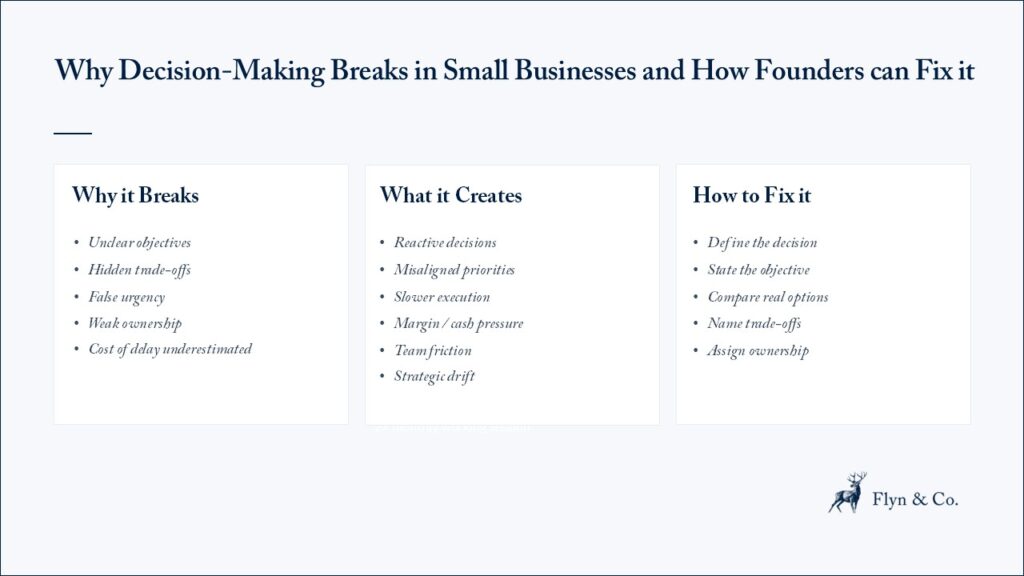
Small businesses do not need corporate committees. They need lightweight discipline.
Decision-making gets harder when the business becomes more complex
In the early stage of a business, decisions are often direct, ready to execute. The founder sees the problem, understands the customer, controls the cash (or tries to), and knows the team personally. That proximity is powerful. It creates speed.
But as the business grows, speed alone becomes less reliable. More people are involved. More costs are fixed. More customers behave differently. More decisions have second-order consequences. A choice made in sales affects operations. A hiring decision affects cash. A pricing decision affects positioning. A supplier decision affects working capital.
The founder is no longer deciding only what to do. The founder is deciding what the business is becoming. That is a very different type of decision.
Most decision problems are not technical
When a decision becomes difficult, leaders often look for more data : Sales, Financial Analysis, Customer Feedback, Benchmark information.
Sometimes that helps. But often the real issue is not a lack of data. It is that the decision itself has not been framed properly.
Many decision problems in SMEs come from 4 basic weaknesses:
- The objective is not explicit
- The options are not clearly defined
- The trade-offs are not named
- The owner of the decision is unclear
That is why 2 intelligent people can look at the same situation and argue past each other.
- One person is optimising for growth.
- Another is optimising for cash.
- A third is trying to reduce operational complexity.
- A fourth is protecting customer experience.
They are not necessarily disagreeing about the facts. They are disagreeing about what matters most. Until that is clarified, more analysis may only create more noise.
Urgency often creates false clarity
Small businesses are often built under pressure : There is not enough time, not enough cash, bot enough management bandwidth, not enough certainty…
That pressure creates urgency, and urgency can be useful. It prevents endless debate. It keeps the business moving.
But urgency also creates false clarity.
When a decision feels urgent, leaders often skip the most important questions:
- What are we actually deciding?
- What are we trying to optimise?
- What happens if we wait?
- What happens if we act too soon?
- Is this decision reversible?
- What would make this decision wrong?
Instead, the business moves quickly because speed feels like control. But speed is not the same as clarity. A fast decision based on a vague objective is still a weak decision.
Founders often confuse activity with progress
This is one of the most common traps.
Small businesses generate endless activity: sales calls, recruitment discussions, product improvements, customer requests, marketing ideas, cost reviews, supplier negotiations, operational fixes.
Activity feels productive because it is visible. But not all activity creates value.
A company can be very busy and still avoid its most important decisions. It can launch new initiatives while failing to fix pricing. It can hire more people while avoiding role clarity. It can chase growth while ignoring margin quality. It can improve reporting while avoiding the harder question of what decisions the reporting should support.
Progress requires choice.
That means saying:
- This matters more than that
- This initiative gets funded
- This one stops
- This customer is not worth the complexity
- This hire is not yet justified
- This opportunity is attractive, but not now
Small businesses (SMEs) often need better prioritisation.
Weak decisions often start with unclear objectives
A decision without a clear objective usually defaults to emotion, politics, or habit.
For example, imagine a founder asking: “Should we hire a salesperson?”
That question is too vague. A better version would be: “Should we hire a salesperson in Q3 to increase qualified pipeline in our highest-margin segment, while keeping fixed costs within our current cash runway?”
Now the decision has shape.
- The objective is clearer.
- The timing is clearer.
- The financial constraint is clearer.
- The commercial logic is clearer.
That does not make the decision easy, but it makes the discussion more useful. Many founder decisions improve immediately when the objective is rewritten in plain language.
- Not “should we grow?” But “what kind of growth are we willing to fund?”
- Not “should we cut costs?” But “which costs weaken value creation, and which costs protect future performance?”
- Not “should we enter this market?”
But “does this market improve our strategic position enough to justify the execution burden?” The quality of the decision depends heavily on the quality of the question.
Trade-offs need to be named earlier
Every meaningful business decision contains a trade-off.
- Growth versus profitability. An eternal trade-off…
- Speed versus control.
- Flexibility versus commitment.
- Cash preservation versus investment.
- Customer satisfaction versus operational complexity.
- Short-term revenue versus long-term positioning.
Small businesses often make poor decisions because they pretend the trade-off is not there.
For example, discounting may improve short-term conversion, but it can damage margin and price perception. Hiring may reduce founder overload, but it increases fixed cost. Expanding the offer may increase revenue potential, but it can fragment execution. Saying yes to a large customer may help cash, but create dependency and operational strain.
The decision does not become better by hiding the trade-off. It becomes better when the trade-off is explicit. That is when leadership can ask the right question: “Are we comfortable making this trade-off now?”
Decision ownership matters more than consensus
In small businesses, decisions often sit in an ambiguous space. They’re often attributed to the founders.
Everyone has an opinion. Several people contribute inputs. The founder makes the final call, sometimes formally, sometimes by default. The team then executes with different levels of commitment.
This creates a problem: consensus is confused with ownership. A good decision process does not require everyone to agree. But it does require clarity on who owns the recommendation, who provides input, who decides, and who executes.
Without that clarity, decisions become slow before they are made and fragile after they are made.
A simple distinction helps:
- Input owner: provides relevant information
- Recommendation owner: structures the options and proposes a path
- Decision owner: makes the final call
- Execution owner: delivers the outcome
In a small business, the same person may hold several of these roles (not to mention all of them). That is fine. What matters is that the roles are visible.
- When ownership is unclear, accountability becomes emotional.
- When ownership is clear, accountability becomes operational.
The cost of delay is often underestimated
Some decisions are made too fast. Others are delayed for too long.
Founders often delay decisions that involve discomfort:
- Replacing someone
- Increasing prices
- Narrowing the offer
- Stopping an initiative
- Confronting a weak partnership
- Renegotiating terms
- Reducing complexity
The delay can feel prudent. It may even be presented as “waiting for more data.” But sometimes waiting is not neutral. It has a cost.
- A delayed people decision can drain team energy.
- A delayed pricing decision can compound margin leakage.
- A delayed cash decision can reduce financing options.
- A delayed focus decision can keep the business spread too thin.
A better question is not only: “What is the risk of acting?”
It is also: “What is the cost of not acting?”
Founders who ask both questions usually make stronger decisions.
A better decision process does not need to be bureaucratic
Small businesses do not need corporate committees. They need lightweight discipline.
A practical decision process can be simple:
- Define the decision clearly
- State the objective
- Identify the real options
- Name the trade-offs
- Test the downside
- Assign ownership
- Decide what would make management revisit the decision later
That is enough for many situations.
The goal is not to slow the business down. The goal is to avoid making important decisions with an unclear logic. A good process should feel like a sharper conversation, not a heavy procedure.
The founder’s role changes over time
As a business grows, the founder’s role gradually shifts.
At first, the founder is often the best decision-maker because they hold most of the information. Later, that same concentration can become a constraint. The founder cannot remain the only person who sees the full picture, challenges assumptions, and connects decisions to cash, margin, operations, and strategy.
Better decision-making therefore requires a management system, not only better founder instinct. That does not mean the founder becomes less important. It means the founder’s judgment is supported by better structure.
The best founders, more than removing intuition from decision-making, surround it with enough discipline to make it more reliable.
What better decision-making looks like in practice
A stronger decision culture in a small business usually has a few visible signs.
- The team can state what is being decided.
- The objective is clear before the debate starts.
- Options are compared honestly.
- Trade-offs are named without defensiveness.
- Cash impact is considered early.
- Downside is discussed before commitment.
- The decision owner is clear.
- The team knows what will trigger a review.
That is not bureaucracy. That is management maturity.
Final thought
Decision-making breaks in small businesses (including startups) because the business outgrows informal judgment before the leadership team realises it.
The founder’s instinct still matters.
Speed still matters.
Commercial energy still matters.
But as decisions become more consequential, they need more structure. Not more process for its own sake. More clarity.
Better decisions come from asking better questions, naming the real trade-offs, and assigning ownership before the business commits time, capital, and attention.
In a small business, those are scarce resources. That is why decision quality matters so much.
Because growth does not only depend on effort. It depends on what the business chooses to do and what it chooses not to do.
One final word : Stay tuned for more insights on Finance, Investing, Real Estate & Startups.
Need stronger financial discipline behind important decisions?
Flyn & Co. provides Fractional CFO support for founders and SME leaders who need clearer reporting, stronger cash-flow visibility and structured decision support without hiring a full-time CFO.
Explore Fractional CFOMore posts...
Preparing a Board for a Difficult Quarter
How to explain a performance miss and secure decisions while the business still has room to act.
SaaS Financial Planning: How to Turn ARR Growth Into Cash and Enterprise Value
SaaS Financial Planning: How to Turn ARR Growth Into Cash and Enterprise Value ARR growth tells you whether a SaaS company is getting bigger. It
Budget 2027: Build a Plan Your Business Can Actually Use
The strongest budgets make assumptions explicit, quantify the cash impact and define how management will respond.
Why Bordeaux Wine Estates Need a 24-Month Cash Model
Why Bordeaux Wine Estates Need a 24-Month Cash Model Bordeaux’s wine industry is adjusting to lower volumes, shifting consumption, weaker exports and structural vineyard contraction.
Fractional CFO vs. Full-time CFO: Which One Should an SME Choose?
Fractional CFO or full-time CFO? Learn which option makes more sense for SMEs, growing businesses, and founder-led companies that need financial leadership without overbuilding the finance function.
Bordeaux Neighborhoods for Property Investment: Which Signals Matter Most?
Learn how to assess Bordeaux neighborhoods for property investment using four key signals:
tenant demand, entry basis, capex risk, and exit depth. A practical framework for smarter real estate
decisions.