
Hospitality Consulting
Financial clarity for hotels, serviced apartments and short-term rental businesses.
Flyn & Co. helps hospitality owners, operators and investors connect occupancy, room rates and booking channels with profit, cash flow and investment returns.
Whether you are managing seasonal cash pressure, reviewing property performance or evaluating a renovation or acquisition, we build the financial analysis needed to make the decision.
Turn operating performance into financial decisions
A busy property can still face weak margins or a cash shortfall. Our hospitality financial consulting connects trading performance with distribution costs, staffing, capital expenditure and funding needs.
Explore hospitality support
Hospitality finance built around the decisions ahead
We support independent hotels, serviced apartments, short-term rental portfolios and hospitality investors. Each engagement starts with the decision you need to make and the financial evidence it requires.
- Explain why stronger occupancy is not translating into higher profit
- Plan liquidity through the low season and periods of renovation
- Compare direct bookings with online travel agency channels after acquisition and operating costs
- Build a financial model for an opening, refurbishment or acquisition
- Prepare forecasts and financial materials for lenders, investors or shareholders
Outputs can include a property-level P&L, a rolling cash forecast, a channel contribution analysis or an investment model with explicit assumptions and downside scenarios.
Hotel profitability and seasonal cash flow

Hospitality performance depends on how room revenue converts into contribution, operating profit and cash. We connect occupancy and average daily rate with channel costs, housekeeping, payroll, utilities, maintenance and the timing of receipts and payments.
For portfolios, a consistent property-level view helps identify which assets fund the business and which require management attention.
Questions owners and operators bring to us
- Which properties, room types and channels generate the strongest contribution?
- How much occupancy is needed to cover the operating cost base?
- What cash buffer is required before low season?
- How do discounts, cancellations and longer stays change the economics?
- Which costs should flex with demand, and which commitments are fixed?
Financial analysis you can use
- Monthly hospitality budgets and rolling forecasts
- 13-week cash flow forecasts and seasonal funding scenarios
- Property, channel and room-type profitability analysis
- Break-even occupancy and sensitivity testing
- Management reporting with actions, owners and review dates
Explore our fractional CFO services for recurring finance leadership and our FP&A support for budgeting and reporting.
Hospitality investment and financial modeling
Before acquiring, renovating or repositioning a hospitality asset, test the investment against its operating assumptions. A model should connect room inventory, seasonal demand, achievable rates, operating costs and capital expenditure with funding needs and investor returns.
Decisions to pressure-test
- Acquisition price and the cash required beyond the purchase
- Renovation costs, closure periods and the pace of reopening
- Rate and occupancy assumptions during the ramp-up
- Lease, management and ownership structures
- Debt servicing, refinancing and exit assumptions
An explicit investment case
- Hospitality business plans and integrated financial models
- Base, downside and phased investment scenarios
- Cash flow, debt service and equity return analysis
- Valuation assumptions and investment committee materials
- Financial due diligence preparation and decision memos
See our financial modeling, business valuation and real estate advisory capabilities.
Corporate finance services for hospitality
Choose a focused assignment or recurring finance support, depending on the decisions and internal resources involved.
Financial Planning & Analysis
Connect room revenue, payroll and seasonal demand with budgets, cash forecasts and a consistent management review.
Financial Modeling
Model openings, renovations and acquisitions with explicit rate, occupancy, cost, capex and financing assumptions.
Business Valuation
Assess value ranges using operating performance, investment needs and the assumptions behind sustainable cash flow.
Fractional CFO
Build a recurring finance rhythm for cash, forecasts and property performance through direct senior advisory support.
Startup Founder Advisory
Prepare the business plan, financial model and funding case behind a new hospitality venture or expansion.
Management Consulting Solutions
Evaluate growth, positioning, pricing and operating priorities through their effects on profit, cash and execution.
Direct bookings and platform economics
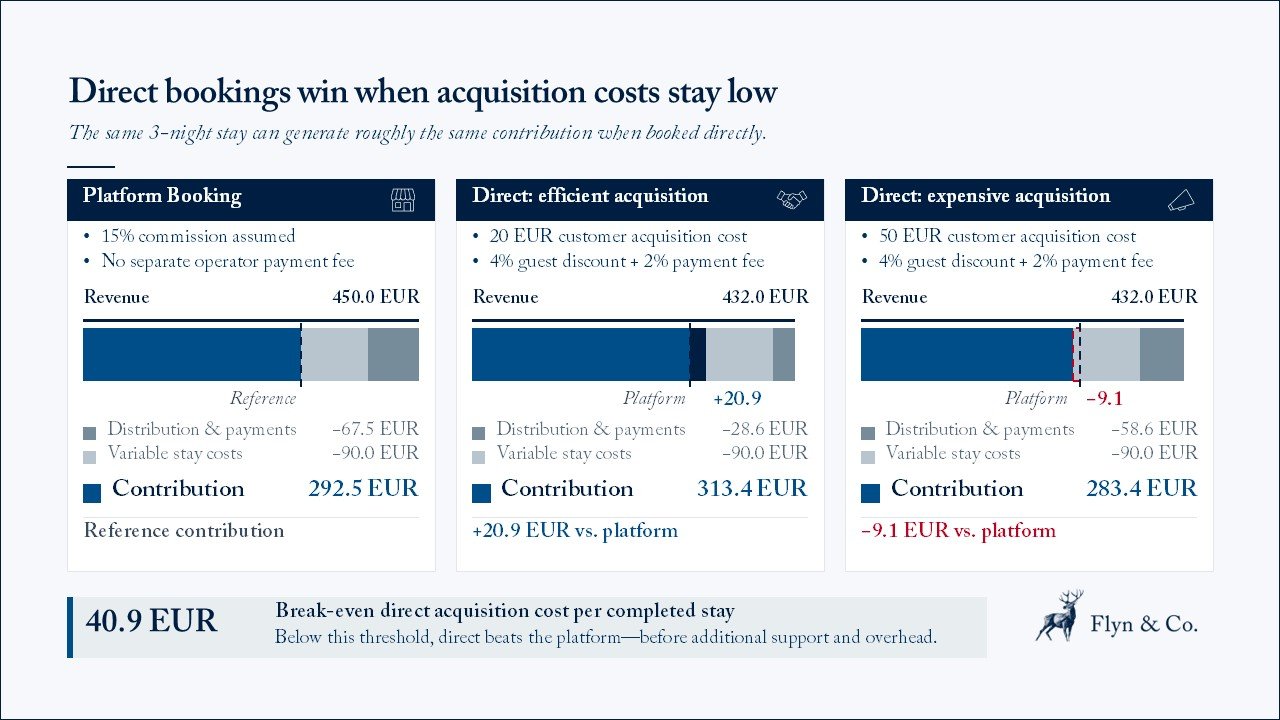
The right channel mix depends on the contribution each booking leaves after commissions, discounts, payment fees, acquisition spending and variable stay costs. Compare the same stay on a consistent basis before reallocating your marketing budget.
In Flyn’s illustrative three-night stay, the platform booking produces a €292.5 contribution. Direct booking produces €313.4 with €20 acquisition cost, but €283.4 with €50 acquisition cost. The break-even direct acquisition cost is approximately €40.9 per completed stay, before additional support and overhead.
This is a worked example with stated assumptions. Your result will depend on the actual channel economics and stay costs. Read Airbnb, Booking and Expedia — who captures the value of travel? for the full analysis.
The hospitality metrics behind the decision
Use operating metrics alongside profit and cash measures. Definitions and reporting periods should stay consistent across properties and channels.
Occupancy and average daily rate
Occupancy shows rooms sold as a share of available rooms. Average daily rate (ADR) is room revenue divided by rooms sold. Reviewing them together helps explain how volume and price affected trading.
Revenue per available room
RevPAR is room revenue divided by available room-nights. It combines rate and occupancy, while a separate cost view is needed to assess what the revenue contributes to profit.
Contribution by booking channel
Compare room revenue after channel commissions, discounts, payment fees, acquisition costs and variable stay costs. Keep the cost definitions consistent before deciding which bookings create more value.
Operating profit and cost flexibility
Track payroll, housekeeping, utilities, maintenance and other operating costs against activity. Separate costs that vary with occupancy from commitments that persist through quieter months.
Liquidity and investment capacity
Test the cash left after operating payments, capital expenditure and debt service. A profitable year can still contain months that require extra liquidity. Our finance resources explain cash forecasting and reporting methods.
Metric definitions are consistent with the STR hotel glossary.
How a hospitality engagement works
1. Define the decision
Clarify the property or portfolio, the ownership and operating structure, the decision deadline and the financial outcome you need to evaluate.
2. Review the financial and operating information
Review monthly financials, occupancy and rates, channel mix, booking and cancellation data, payroll, capex, financing and existing forecasts.
3. Reconcile the operating drivers
Connect property and booking data with financial results. Identify missing costs, inconsistent definitions and assumptions that need to be challenged.
4. Build the analytical view
Build the forecast, channel analysis or investment case, then test downside scenarios for demand, rates, costs, works and funding.
5. Deliver decision-ready recommendations
Deliver a clear financial view, the sensitivities that matter and a set of management actions. Agree ownership and the review cadence for any ongoing support.
Discuss your hospitality challenge
Tell us about your property or portfolio, what you need to decide and when. We can discuss the analysis, financial model or recurring support that would help you move forward.
Explore all consulting industries or learn more about Flyn & Co.