
Budget 2027: Build a Plan Your Business Can Actually Use
Why This Matters Now
A useful budget is not a prediction of one number. It is a management system that connects strategic choices, operating drivers, cash consequences & actions.
By the second half of 2026, many leadership teams are already opening the Budget 2027 cycle. The familiar temptation is to take the latest forecast, roll it forward, add a growth percentage and ask each function to reduce its first cost submission. That may produce a spreadsheet on time. It rarely produces a plan that management can genuinely use.
The real purpose of the new Budget = is not to predict December 2027 with false precision. It is to translate strategy into a coherent set of operating and financial choices: where growth will come from, which capacity must be funded, what margin is acceptable, how much cash the plan consumes, and what management will do if reality moves away from the base case.
The external outlook is not stable enough for a single-point budget. Here in Europe, annual inflation reached 2.9% in July 2026. The ECB’s June baseline projects 2.3% inflation and 1.2% real GDP growth in 2027, while its severe illustrative scenario shows 5.3% inflation and only 0.4% growth. Companies need one operating logic, several scenario paths, and clear decision triggers.
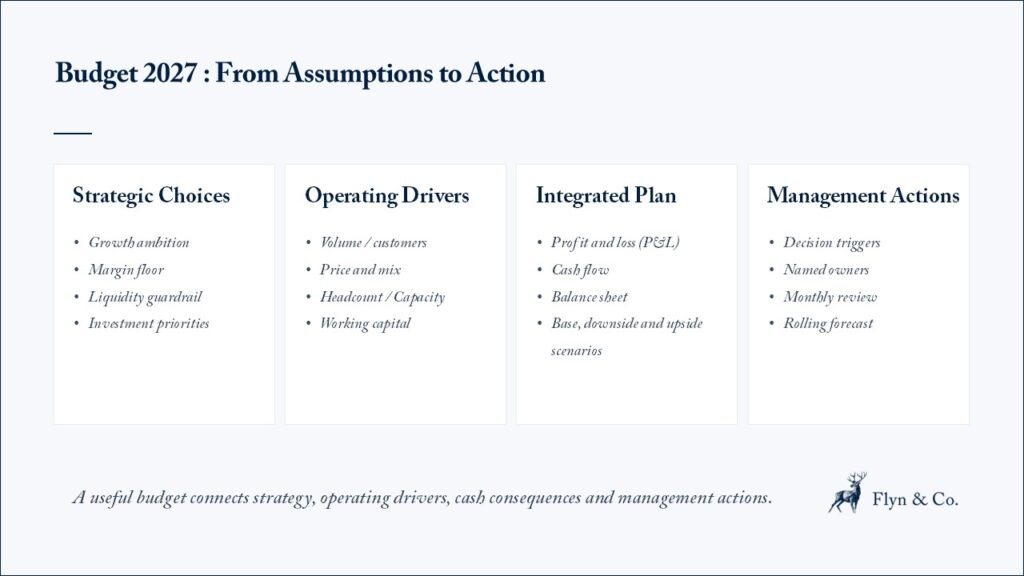
Budget should connect the financial statements : P&L, cash flow and balance sheet on a monthly basis.
1. Start With Decisions, Not Last Year's Ledger
A budget becomes weak the moment it is treated as an accounting exercise. The general ledger explains the historical baseline, not the operating choices that will shape 2027.
Start from the latest 2026 outlook and, just as importantly, the exit run rate, a full-year average can hide a business entering January at a very different level of revenue, headcount or cost than it carried earlier in the year. Known carryover effects (signed contracts, recent hires, price increases, leases, debt service, committed projects) should be separated from new 2027 choices.
Before detailed submissions begin, management should settle a small number of guardrails:
- What revenue growth ambition is credible, and which customer, product or geographic engines support it?
- What gross margin or contribution-margin floor should the business protect?
- How much liquidity, covenant headroom or minimum cash should remain available?
- Which investments (Capex) are strategic commitments, and which are conditional on performance?
- Which trade-offs take priority if growth, profitability and cash cannot all be maximised at once?
Those questions turn the budget from a negotiation over cost lines into a capital-allocation process.
Make Budget 2027 useful beyond approval day
If your current process relies on historical reporting, fragmented spreadsheets or a single base case, Flyn & Co. can help you build a driver-based budget that connects performance, cash flow and management actions throughout 2027.
2. Build Revenue And Margin From Operating Drivers
Revenue projection on Budget should not begin with “Revenue 2026 +8%.” Our recommendation is that revenue should begin with the few variables (called Drivers) management can observe, influence and challenge. The exact model depends on the business, but the logic is consistent across drivers such as customers or units, conversion, churn, price, discount and mix for revenue; product mix, input cost and delivery productivity for gross margin; headcount, hires, attrition and ramp-up for people costs; and contracted versus discretionary spend for operating costs.
For a subscription business (such as SaaS), the revenue bridge may separate opening recurring revenue, new customers, expansion, contraction and churn. On the other hand, for a project-based business, it may combine backlog, win rate, delivery capacity and project timing. For retail or hospitality, volume, average ticket, occupancy, price and channel mix may matter more.
The point is to build the simplest model that explains how the business makes money and where that logic could break.
3. Integrate The P&L, Cash Flow And Balance Sheet
A profitable budget can still create a financing problem. EBITDA does not show when customers pay, when inventory is purchased, when VAT or payroll taxes fall due, when Capex is paid, or when debt must be serviced.
Budget 2027 should connect the financial statements : P&L, cash flow and balance sheet on a monthly basis. At minimum, the model should make working capital, Capex, Financing, tax and one-off items explicit. A change in revenue should flow through receivables; a hiring decision should affect payroll by start month; an investment should affect cash before it affects depreciation.
Practical test: if the leadership team cannot see the month of minimum cash, the main causes of that low point, and the available headroom, the budget is not yet decision-ready.
Businesses with tight liquidity should complement the annual budget with a shorter, frequently updated cash forecast. The annual model sets direction; a 14-week cash view supports near-term control. They serve different decisions and should reconcile rather than compete.
4. Use Scenarios To Pre-Decide Management Actions
Three scenarios are usually enough: base, downside and upside. They should share the same model architecture and vary only the assumptions that materially change outcomes. Each scenario should contain management responses, a downside case that merely shows lower EBITDA is incomplete. It should identify what the company would stop, defer, renegotiate or accelerate, and when.
- Base : core demand, price, margin and working-capital assumptions remain within tolerance: execute the approved hiring and investment sequence, review monthly.
- Downside : illustrative triggers such as bookings below 90% of plan for two months, margin two points below plan, or DSO up 10 days: tighten weekly cash control, pause conditional hires, review pricing, procurement and discretionary spend.
- Upside : illustrative triggers such as demand above 110% of plan or capacity consistently constrained: release phased capacity and Capex, protect service quality, reassess cash needs before accelerating.
Of course, the thresholds are illustrative : each company should calibrate them to its own sales cycle, operating leverage, liquidity and capacity. The discipline is what matters: signals are defined before pressure rises, and responses are discussed before they become urgent.
5. Assign Ownership, Run The Calendar, Build The Cadence
Ownership. Finance owns the architecture, consolidation and integrity of the model, not every assumption.
- Commercial leaders own pipeline, conversion, price and retention.
- Operations own productivity, capacity and service constraints.
- People leaders own the hiring calendar and compensation assumptions.
- Finance then challenges consistency, avoids double counting, and translates the operating plan into financial consequences.
Calendar.
- August-September: set strategic priorities, guardrails and the latest 2026 estimate, appoint assumption owners.
- September-October: build revenue, margin, headcount, opex and investment drivers into the first integrated model.
- October-November: challenge assumptions, test capacity and cash, model scenarios and resolve major trade-offs.
- November-December: approve the plan, phase it monthly, assign KPIs and actions. From January: compare actuals with budget, explain drivers, update the rolling forecast, and act on triggers.
Cadence. A decision-ready output includes an integrated monthly P&L, cash-flow and balance-sheet view; a clear bridge from the 2026 exit run rate to the 2027 plan; drivers and KPIs with named owners; base, downside and upside scenarios with defined triggers; a risk-and-opportunity log; and a rolling forecast that updates the outlook without rewriting the approved baseline.
Budget 2027 Should Be A Management Contract
The strongest budgets do not remove uncertainty. They organise it. They make assumptions explicit, connect strategy to operating drivers, show the cash consequences of decisions, and define what management will do when conditions change. They give the leadership team a common language for growth, profitability, investment and risk.
For companies beginning Budget 2027 in the second half of 2026, the priority is not to add more detail. It is to create a model and a process that can be challenged, understood and used. A budget that achieves that becomes more than an annual target — it becomes a management contract for the year ahead.
Flyn & Co. perspective: if your current process relies on historical accounting reports, disconnected spreadsheets or limited cash visibility, the right intervention is often focused — clarify the drivers, rebuild the integrated forecast, and install a practical review cadence.
One final word : Stay tuned for more insights on Finance, Investing, Real Estate & Startups.
More posts...
Preparing a Board for a Difficult Quarter
How to explain a performance miss and secure decisions while the business still has room to act.
SaaS Financial Planning: How to Turn ARR Growth Into Cash and Enterprise Value
SaaS Financial Planning: How to Turn ARR Growth Into Cash and Enterprise Value ARR growth tells you whether a SaaS company is getting bigger. It
Why Bordeaux Wine Estates Need a 24-Month Cash Model
Why Bordeaux Wine Estates Need a 24-Month Cash Model Bordeaux’s wine industry is adjusting to lower volumes, shifting consumption, weaker exports and structural vineyard contraction.
Fractional CFO vs. Full-time CFO: Which One Should an SME Choose?
Fractional CFO or full-time CFO? Learn which option makes more sense for SMEs, growing businesses, and founder-led companies that need financial leadership without overbuilding the finance function.
Bordeaux Neighborhoods for Property Investment: Which Signals Matter Most?
Learn how to assess Bordeaux neighborhoods for property investment using four key signals:
tenant demand, entry basis, capex risk, and exit depth. A practical framework for smarter real estate
decisions.
When Revenue Growth Becomes Dangerous: The Cash Flow Side of Scaling Too Fast
In small businesses, growth can consume cash faster than it creates it. The danger is not growth itself, but growth that stretches working capital, weakens margins, increases fixed costs, and hides liquidity risk behind a positive sales story.