
Why Bordeaux Wine Estates Need a 24-Month Cash Model
Bordeaux’s wine industry is adjusting to lower volumes, shifting consumption, weaker exports and structural vineyard contraction. Vineyard industry is changing.
For many estates here in Bordeaux, the priority is building a financial model that connects inventory, cash, debt and strategic choices.
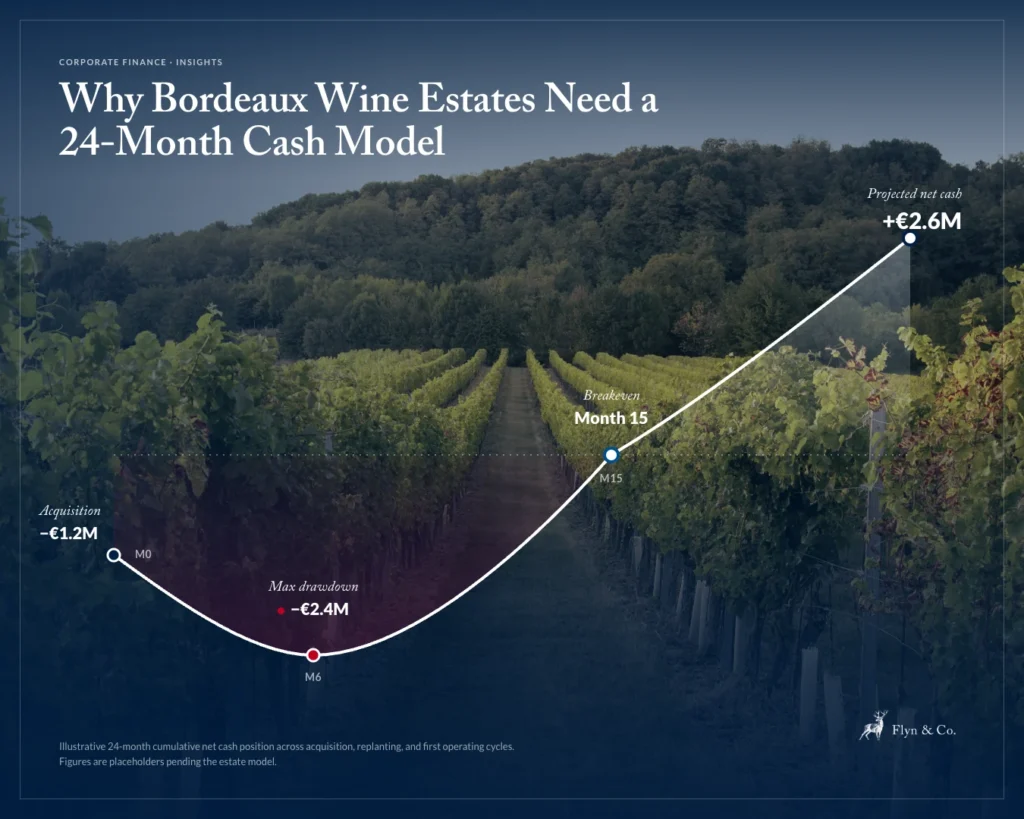
From the acquisition to breakeven : Bordeaux Wine Estates need a structured Cash Model
The Annual Budget Was Designed for a More Predictable Business
Most annual budgets assume a relatively clean relationship between production, sales and cash.
Revenue is forecast by market condition and / or product. Costs are projected based on the previous year. Investment is added separately. Management then measures actual performance against budget.
That process can work when volumes, prices and customer behaviour remain broadly stable.
Wine does not operate that way.
A Bordeaux Estate may incur vineyard costs continuously throughout the year, concentrate significant expenditure around the harvest, hold wine through élevage, commit to bottling and packaging months before final sales, and wait again before receiving cash from distributors or négociants.
The cash cycle can therefore extend well beyond the period in which the underlying costs were incurred.
An estate may be profitable in accounting terms and still face a liquidity shortage. It may also report a strong inventory position while holding wine that is slow-moving, insufficiently differentiated or unlikely to sell at the price assumed in the accounts.
Will the wine estate make a profit this year?
The more important Corporate Finance question is:
How much cash will the estate require, when will it require it, and what happens if sales are delayed or achieved at a lower price?
An annual budget alone rarely answers that question.
Does your wine estate have clear visibility over the next two harvest cycles?
Flyn & Co. helps founders, shareholders and operators build decision-ready financial models covering cash flow, inventory, funding needs and strategic scenarios.
Wine Inventory Is an Asset, but It Is Also Cash Waiting to Return
Inventory is central to the economics of a wine estate.
It represents accumulated agricultural, production, maturation, bottling and packaging costs. For higher-value wines, ageing can support future pricing and brand positioning. For other estates, stock provides flexibility to manage vintages and commercial timing.
But inventory is not automatically liquidity. It becomes liquidity only when the wine is sold, invoiced and collected. It takes time.
That distinction is increasingly important in Bordeaux. Gironde department produced approximately 3.2 M hl in 2025, of which 83% was red wine. Yet red wine is also the segment most exposed to changing domestic consumption patterns, while international shipments have been under pressure.
A strong financial model for a wine estate should therefore separate inventory into economically meaningful categories:
- Wine in bulk
- Wine undergoing élevage
- Bottled and saleable inventory
- Committed inventory linked to confirmed orders
- Uncommitted finished goods
- Slow-moving or commercially vulnerable vintages
Two estates with an identical inventory value can face entirely different liquidity positions. One may have confirmed export orders and predictable collection dates. The other may hold several vintages without sufficient visibility over timing, price or channel.
The accounting balance may look similar. The Corporate Finance risk is not.
A 24-Month Horizon Captures the Real Operating Cycle
Why 24 months of Forecasting ? Because 12 months can be too short to connect one harvest, the commercialisation of earlier vintages, the next production cycle and the related financing requirement.
A useful Financial model should show at least:
- Current inventory and expected conversion
- Sales by vintage, product, geography and channel
- Customer payment timing
- Vineyard and winery operating costs
- Harvest expenditure
- Bottling and packaging commitments
- Taxes and social charges
- Maintenance and essential Capital Expenditures (CapEx) for the estate
- Debt service
- Available facilities and covenant headroom
- Shareholder or family funding where relevant
The objective is to expose the periods in which the estate becomes financially vulnerable.
For example, the model may show that the base case remains manageable until the second harvest, when bottling costs, debt repayments and weaker collections converge. That insight gives management time to act.
Without it, the business may discover the problem only when supplier invoices become due.
Start With Volume, Price, Channel and Collection—Not Revenue Alone
Revenue forecasting for a wine estate should be driver-based. Accordingly to our criteria at Flyn, the model should separate four variables:
1. Volume
How many bottles or hectolitres are expected to sell? The assumption should reflect actual order visibility, distributor inventory and recent sales performance—not only production capacity.
2. Net selling price
What will the estate receive after discounts, commissions, promotional support and commercial concessions? Headline price and cash contribution are not the same.
3. Channel mix
Direct sales, export distribution, négociants, hospitality, e-commerce and wine tourism have different margins and working-capital profiles. A higher-margin channel may require more internal commercial investment. A lower-margin channel may convert inventory more quickly.
4. Collection timing
When will the cash actually arrive? A sale forecast that ignores payment terms is not a cash forecast.
These variables should be modelled separately because management can act on them differently. Price pressure may require repositioning. Weak volume may require channel diversification. Slow collections may require tighter credit control or financing.
Combining everything into one revenue line hides the decision.
The Estate Needs Three Cases
The annual budget usually presents management with a single expected outcome. That is insufficient when both market demand and production conditions are uncertain.
A Bordeaux wine estate should model at least three cases:
- Base case — The most realistic outcome based on current order visibility, recent sales, pricing and collection behaviour.
- Downside case — A credible stress case reflecting lower volumes, slower collections, price reductions, weaker exports or unexpected production costs.
- Strategic case — A scenario incorporating management action—for example, acreage reduction, a different channel mix, delayed capex, inventory clearance, additional wine-tourism revenue or asset disposal.
The strategic case is important because it distinguishes forecasting from passive observation.
Management should not only ask what happens if the market deteriorates. It should ask which actions materially improve liquidity and enterprise value.
Working Capital Should Become a Board-Level Discussion
In many family-owned or founder-led estates, working capital is treated as a consequence of the business rather than as something management can actively control.
That needs to change. Four areas deserve regular review.
Receivables : Which customers are paying later than expected? How concentrated is the exposure? Are payment assumptions based on contractual terms or actual behaviour?
Inventory : Which vintages and product lines are converting into cash? Which are accumulating? Is the carrying value commercially realistic?
Supplier terms: Can bottling, packaging, logistics or agricultural purchases be scheduled more closely to expected sales?
Financing : Are facilities aligned with the operating cycle, or is the estate using short-term credit to finance structurally long-term needs?
The objective is not simply to reduce working capital at all costs. Holding inventory can be economically rational in wine.
The objective is to understand which working capital creates value and which working capital merely postpones a difficult commercial decision.
Capex Must Compete for Cash
Wine estates often face several legitimate investment requirements at once:
- Vineyard renewal
- Winery equipment
- Energy efficiency
- Environmental compliance
- Cellar renovation
- Bottling facilities
- Visitor infrastructure
- Digital and commercial development
Each project may be strategically attractive. The estate may not be able to finance all of them simultaneously.
A disciplined capital-allocation process should therefore compare investments based on:
- Required cash
- Timing of expenditure
- Expected operating benefit
- Revenue or margin impact
- Implementation risk
- Financing availability
- Reversibility
- Time to cash return
A new wine-tourism facility, for example, should not be justified simply because diversification is strategically desirable. It should be tested against realistic visitor numbers, average spend, staffing needs, seasonality and incremental maintenance.
Similarly, replacing equipment may reduce operating risk without producing visible revenue growth. That can still be the correct investment—but the decision should be explicit.
Capital allocation is not about choosing only projects with the highest theoretical return. It is about choosing the projects the estate can finance and execute without weakening the rest of the business.
Debt Must Be Modelled Against Cash Generation
Wine estates are asset-rich businesses. Land, buildings, brands and inventory may support significant balance-sheet value. But lenders are ultimately repaid from cash, not from prestige.
A property can therefore possess valuable vineyard land and still struggle to service debt from current operations.
A credible financing model should distinguish between:
- seasonal liquidity requirements
- structural working-capital needs
- equipment or renovation financing
- acquisition debt
- shareholder loans
- financing secured against property or inventory
The repayment profile should match the economic life and cash-conversion profile of the underlying use of funds.
Using short-term facilities to finance persistent inventory accumulation is a warning sign. So is relying on property value to compensate for weak operating cash flow without a clear refinancing or disposal strategy.
The question is not only whether the estate has assets. It is whether those assets support a coherent financing structure.
The Model Should Clarify When Restructuring Is Operational and When It Is Financial
Bordeaux’s vineyard removals illustrate the scale of structural adjustment already taking place. But reducing vineyard area is only one possible response.
For an individual estate, restructuring may involve:
- changing the product and colour mix
- reducing unprofitable acreage
- outsourcing part of production
- selling non-core land or buildings
- renegotiating debt
- releasing slow-moving stock
- bringing in a minority investor
- developing wine tourism or direct distribution
- preparing a full or partial sale
These options have different impacts on cash, risk, control and valuation.
Selling land can generate liquidity but reduce future production capacity. Bringing in an investor can strengthen the balance sheet but dilute family ownership. Discounting inventory may accelerate cash conversion but weaken positioning.
A strong Corporate Finance model makes those trade-offs visible before the estate commits.
Valuation Should Separate Heritage From Economic Return
Valuing a Bordeaux wine estate is rarely a single-multiple exercise. The business may contain several components:
- agricultural land
- winery and residential buildings
- machinery and equipment
- wine inventory
- brand and appellation positioning
- distribution relationships
- tourism or hospitality activities
- debt and other liabilities
The estate may also carry emotional and family value that does not translate directly into external market value.
For transaction or succession purposes, management should therefore separate:
1. Asset value — what the land, buildings, equipment and inventory may be worth.
2. Operating value — what sustainable cash flow supports.
3. Strategic value — what a specific buyer may pay for scale, brand, distribution or location.
4. Financial obligations — the debt, deferred investment and working-capital needs a buyer would inherit.
A high asset value does not automatically produce a high equity value. If operations require recurring cash injections, substantial capex or inventory support, those needs will influence what an investor or buyer can rationally pay.
The Management Pack Should Focus on Six Questions
A useful monthly Corporate Finance pack for a Bordeaux wine estate does not need dozens of KPIs. It should answer six questions:
- What cash is available today?
- What is the lowest projected cash point over the next 24 months?
- Which sales and collection assumptions drive that position?
- How much inventory is genuinely converting into cash?
- Which investments and debt payments are committed?
- Which management actions are available if the downside case materialises?
That is enough to move the discussion from historical accounting to forward-looking decisions.
What This Means in Practice
The Bordeaux wine industry remains economically and culturally significant. The sector represented around 60 K direct and indirect jobs and 2.23 B EUR of exports in 2023, according to the CIVB. It is also undergoing one of the most important structural adjustments in its modern history.
That combination—valuable assets, strong heritage and changing economics—is exactly why Corporate Finance matters.
The answer is not to replace wine expertise with spreadsheets. It is to ensure that production, commercial strategy, investment and financing are connected through one coherent financial view.
For many estates, the first step is not another annual budget. It is a 24-month model that management can use to see the pressure points, compare choices and act before liquidity determines the strategy on its behalf.
Final Thought
A Bordeaux wine estate may be built on generations of expertise, valuable land and a respected name. But continuity still depends on cash.
The estates best positioned to navigate the current transition will not necessarily be those with the most optimistic sales forecasts. They will be those that understand:
- how long their cash cycle really is
- which inventory is creating value
- which assets are consuming capital
- how much downside the balance sheet can absorb
- which strategic decisions must be taken early
Corporate Finance can prevent uncertainty from becoming loss of control.
References
More posts...
Preparing a Board for a Difficult Quarter
How to explain a performance miss and secure decisions while the business still has room to act.
SaaS Financial Planning: How to Turn ARR Growth Into Cash and Enterprise Value
SaaS Financial Planning: How to Turn ARR Growth Into Cash and Enterprise Value ARR growth tells you whether a SaaS company is getting bigger. It
Budget 2027: Build a Plan Your Business Can Actually Use
The strongest budgets make assumptions explicit, quantify the cash impact and define how management will respond.
Fractional CFO vs. Full-time CFO: Which One Should an SME Choose?
Fractional CFO or full-time CFO? Learn which option makes more sense for SMEs, growing businesses, and founder-led companies that need financial leadership without overbuilding the finance function.
Bordeaux Neighborhoods for Property Investment: Which Signals Matter Most?
Learn how to assess Bordeaux neighborhoods for property investment using four key signals:
tenant demand, entry basis, capex risk, and exit depth. A practical framework for smarter real estate
decisions.
When Revenue Growth Becomes Dangerous: The Cash Flow Side of Scaling Too Fast
In small businesses, growth can consume cash faster than it creates it. The danger is not growth itself, but growth that stretches working capital, weakens margins, increases fixed costs, and hides liquidity risk behind a positive sales story.