
Fractional CFO vs. Full-time CFO: Which One Should an SME Choose?
At some point, a growing business outgrows basic finance support.
The founder can no longer rely only on accounting reports or simple PowerBI Exports. The company needs better forecasts, clearer cash visibility, sharper margin analysis, stronger reporting, financing support, and a more disciplined view of growth decisions.
That is often when the question appears:
Do we need a CFO? The answer may be yes. But the better question is usually more precise:
Do we need a full-time CFO now, or do we need CFO-level support in a more flexible format?
For many SMEs, founder-led companies, and growing businesses, the answer is not immediately a permanent CFO hire. The better first step is often a Fractional CFO. Timing matters.
A full-time CFO is a major organisational commitment. A Fractional CFO can bring senior finance leadership earlier, faster, and more flexibly, without forcing the business to build a finance function before it is ready.
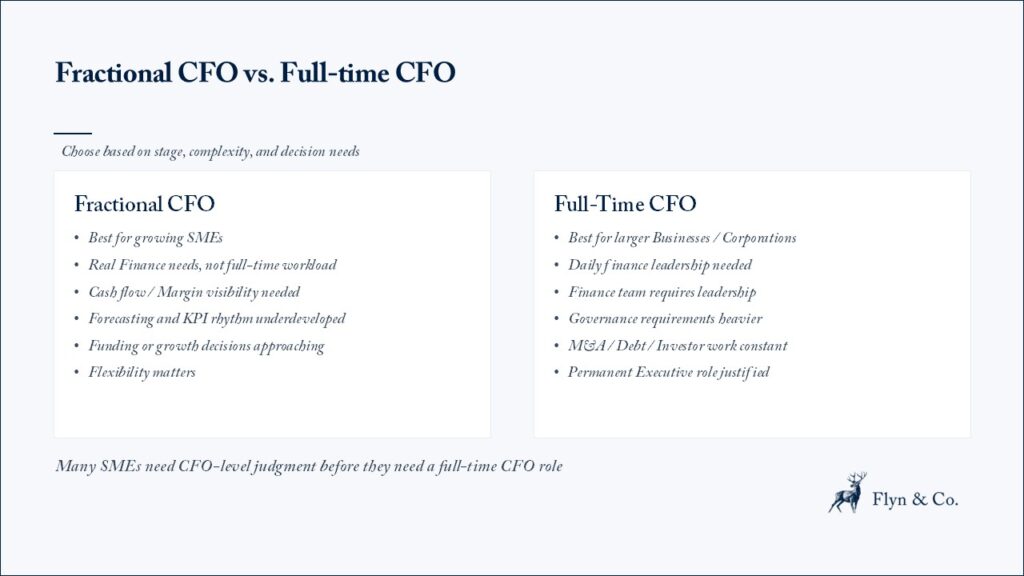
Fractional CFO : do we need a full-time CFO now, or do we need CFO-level support in a more flexible format?
Need CFO-level support, but not ready for a full-time CFO?
Many growing SMEs reach the same point: accounting is in place, but financial visibility is still too limited for confident decisions. If your business needs sharper forecasts, clearer cash visibility, better reporting, or support before a funding, hiring, or growth decision, a Fractional CFO can be the right next step.
Flyn & Co. helps founder-led SMEs build the financial rhythm they need — without overbuilding the finance function too early.
Book a 30-minute diagnostic call to assess what level of CFO support your business actually needs.
The real issue is decision quality
Many founders think about the CFO question too narrowly.
They ask whether they can afford the salary. They ask whether the company is “big enough.” They ask whether investors expect to see a CFO. They ask whether finance is becoming too complex.
Those questions matter. But they do not go far enough. The real issue is decision quality.
A business needs CFO-level support when financial questions start to shape strategic decisions:
- Can we afford to hire?
- Is growth improving or weakening cash flow?
- Which customers are profitable?
- How much working capital does growth consume?
- Should we raise debt or equity?
- Are margins moving for the right reasons?
- What does the downside case look like?
- What KPIs should management review every month?
- What value drivers matter before a sale, acquisition, or fundraising?
These are not bookkeeping questions. They are management questions.
A good CFO, whether fractional or full-time, helps leadership connect financial data to decisions.
What a full-time CFO brings
A full-time CFO can be highly valuable when the company has enough scale, complexity, and internal finance workload to justify the role.
A strong full-time CFO can own:
- Finance strategy
- budgeting and forecasting
- cash flow management
- investor or bank relationships
- reporting and KPIs
- finance team leadership
- risk management
- transaction preparation
- performance management
- capital allocation
For a larger or more complex business, this permanent leadership can be essential.
A full-time CFO is usually the right choice when:
- The business has significant scale
- finance complexity is constant
- there is an internal finance team to lead
- the company is preparing for a transaction or major financing
- management needs daily senior finance presence
- reporting, governance, and compliance requirements are heavy
- the CFO will be deeply involved in operations and leadership routines
In those situations, a full-time CFO can create structure, credibility, and continuity. But that does not mean every SME should hire one immediately.
Why a full-time CFO can be too early
For many SMEs, hiring a full-time CFO too early creates a mismatch.
The business may need senior finance thinking, but not five days per week. It may need forecasting, cash planning, reporting discipline, pricing analysis, or financing preparation — but not a permanent C-level finance executive.
This is where the economics become important.
Cost comparison: Fractional CFO vs. Full-time CFO
Understanding the cost difference is critical when making this decision.
A full-time CFO typically represents a significant fixed investment:
- Base salary: €120,000 to €250,000+ depending on market and experience
- Bonuses and incentives: 10% to 40% of salary
- Employer taxes and benefits: 20% to 40% additional cost
- Total annual cost: often €160,000 to €350,000+
This cost is fixed, regardless of how much CFO-level work is actually required each month.
A Fractional CFO, by contrast, is variable and scalable:
- Monthly retainer or part-time engagement: €2,000 to €10,000+ depending on scope
- Typical annual cost: €25,000 to €120,000
- No long-term employment commitment
- No additional overhead (benefits, bonuses, payroll taxes)
The key difference is cost alignment with actual need.
A business that only requires 1–3 days of CFO-level input per month does not need to carry a full-time executive cost. A Fractional CFO allows the company to pay for senior expertise in proportion to the workload.
This is why many SMEs choose fractional support first: it preserves cash, reduces fixed overhead, and keeps financial leadership flexible.
What a Fractional CFO brings
A Fractional CFO provides CFO-level support on a part-time, flexible, or retainer basis. The business gets senior financial leadership without hiring a permanent executive.
This can include:
- P&L and Cash flow forecasting
- Monthly / Quarterly reporting
- KPI dashboards
- Budget and rolling forecast processes
- Pricing and margin analysis
- Working capital discipline
- Fundraising or debt preparation
- Board or investor reporting
- Scenario planning
- Financial model generation / review
- Strategic finance support
- Transaction readiness
The key point is that a Fractional CFO is not simply an outsourced accountant or FP&A.
Accounting records what happened. A Fractional CFO helps management decide what to do next.
That distinction matters. A qualified Fractional CFO gives the founder a more structured financial view of the business, without requiring the company to carry the full cost and management structure of a permanent CFO.
The main advantage: senior finance support without overbuilding
The strongest argument for a Fractional CFO is not cost alone.
It is fit.
Many SMEs are in the middle zone: too complex for basic accounting, but not yet complex enough for a permanent CFO.
That is exactly where a Fractional CFO can be most useful.
The business may need:
- one or two senior finance reviews per month
- a monthly management pack
- a 13-week cash forecast
- a rolling forecast
- a funding-readiness model
- margin analysis
- board-style reporting
- structured decisions around hiring, pricing, or investment
Those needs are real.
But they may not require a full-time executive.
A Fractional CFO allows the company to access the level of thinking it needs, at the level of intensity it can justify.
That is often the better capital allocation decision.
Fractional CFOs are especially useful when the business is growing
Growth is one of the best moments to bring in Fractional CFO support.
Why?
Because growth creates financial questions that accounting alone cannot answer.
Revenue may be increasing, but:
- Cash may be tightening
- margins may be moving
- working capital may be expanding
- hiring may be ahead of revenue
- customer concentration may be rising
- pricing may be inconsistent
- reporting may be too slow
- the founder may be making decisions without enough visibility
This is where a Fractional CFO can create immediate value.
The role helps the founder understand whether growth is financially healthy, whether the business is scaling profitably, and whether cash can support the plan.
That is often more useful than waiting until the business is large enough to justify a full-time CFO.
Fractional CFOs can be more objective
A Fractional CFO can also bring useful distance. A full-time executive is embedded in the company. That has advantages, but it can also make it harder to challenge internal assumptions. A Fractional CFO often sits close enough to understand the business, but far enough to ask sharper questions.
For example:
- Is this revenue actually profitable?
- Are we hiring too early?
- Is the forecast realistic?
- Are we delaying a pricing decision?
- Are we financing customers through weak payment terms?
- Is the founder overestimating cash runway?
- Are management reports too detailed but not decision-useful?
This external senior perspective can be valuable, especially for founder-led companies where decisions often depend heavily on founder instinct.
The goal is to pressure-test it.
Fractional CFOs are flexible by design
Another advantage is flexibility.
A business may need different levels of finance support at different moments.
For example:
- Light monthly support during stable periods
- deeper involvement during fundraising
- intensive support during cash pressure
- project-based work for a bank discussion
- stronger reporting during growth
- transaction readiness before a sale or acquisition
- temporary support while recruiting an internal finance lead
A full-time CFO is a fixed structure. A Fractional CFO can scale up or down around the business need.
That flexibility matters for SMEs because the financial workload is rarely constant. Some months require strategic finance support. Other months require reporting rhythm, cash control, and decision discipline.
A fractional model adapts better to that reality.
The founder gets a finance partner, not just a finance function
Many SMEs do not only need better finance outputs.
They need a better financial conversation.
A Fractional CFO can help the founder think through questions such as:
- What is the right growth pace?
- Which products or customers deserve more focus?
- How much cash buffer should we protect?
- Which costs are investment and which are drift?
- What should we show lenders or investors?
- What decisions should be made this month?
- What does the downside case tell us?
- What should the management team review every month?
That kind of discussion is often missing in SMEs.
The accountant may be accurate.
The bookkeeper may be reliable.
The founder may know the business well.
But the decision layer is underdeveloped.
A Fractional CFO helps build that layer.
When a full-time CFO is the better choice
The Fractional CFO model is powerful, but it is not always the final answer.
A full-time CFO becomes more appropriate when finance leadership needs to be permanent, daily, and deeply embedded in the organisation.
This may be the case when:
- the business has reached significant scale
- the finance team needs full-time leadership
- the company has complex reporting requirements
- fundraising, M&A, or debt management is constant
- investors require senior in-house finance leadership
- operational finance issues are daily and material
- the CFO role is central to executive management
In those cases, the company may have outgrown fractional support.
But this is exactly the point: the Fractional CFO can be the bridge to that moment.
It can help the company professionalise finance before it makes the full-time hire. It can also help define what the future CFO role should actually include.
That reduces hiring risk later.
Fractional CFO vs. full-time CFO: how to compare
The decision should not be emotional. It should be based on need, intensity, timing, and economics.
| Question | Fractional CFO may be better when… | Full-time CFO may be better when… |
|---|---|---|
| How much finance leadership is needed? | The need is real but not full-time | The need is daily and permanent |
| How complex is the business? | Complexity is growing but manageable | Complexity is high and constant |
| What is the budget? | The company wants senior support without a full C-level cost | The company can justify a permanent executive package |
| How mature is the finance function? | The business needs structure before hiring senior internally | There is already a team and process to lead |
| What is the main objective? | Better forecasts, cash control, reporting, funding readiness, decision support | Full executive leadership, governance, team management, and strategic ownership |
| How flexible does the model need to be? | The workload changes by month or project | The workload is consistently high |
For many SMEs, the fractional option will be the more logical first step.
It gives the business access to senior financial thinking without forcing a premature permanent hire.
Typical situations where a Fractional CFO makes sense
A Fractional CFO can be particularly relevant when:
- Revenue is growing but profitability is unclear
- cash flow is hard to forecast
- the founder lacks a clear management dashboard
- the company is preparing for bank or investor discussions
- pricing and margin discipline need improvement
- working capital is consuming cash
- the business needs a rolling forecast or budget process
- the company is considering hiring, expansion, or acquisition
- reporting is too accounting-led and not management-led
- the founder needs a finance sparring partner
These are common SME situations.
They do not always justify a full-time CFO.
But they do justify CFO-level thinking.
What to expect from a good Fractional CFO
A strong Fractional CFO should bring structure quickly.
The first phase should usually focus on financial visibility:
- what the business earns
- where margin is created or lost
- how cash moves
- what the forecast shows
- which KPIs matter
- where risks are building
- what decisions need to be made
The second phase should move toward rhythm:
- Monthly reporting
- cash reviews
- forecast updates
- KPI ownership
- management actions
- funding or investment decisions
The third phase should improve strategic finance:
- Pricing logic
- scenario planning
- capital allocation
- financing preparation
- investor or lender materials
- transaction readiness
The objective is to give leadership a clearer decision system.
The strongest case for Fractional CFO support
The strongest case for a Fractional CFO is simple:
Many SMEs need CFO-level judgment before they need a full-time CFO role.
That is the real timing issue.
Waiting too long can leave the founder making important decisions without enough financial visibility.
Hiring full-time too early can add fixed cost before the business has enough recurring CFO workload.
A Fractional CFO solves that gap.
It gives the company the financial leadership it needs now, while keeping flexibility for the future.
Final thought
The question is not whether a full-time CFO is valuable. A strong full-time CFO can be transformative at the right stage.
But for many SMEs, the more practical question is whether the business needs permanent CFO capacity — or whether it needs senior finance leadership applied to the right decisions at the right cadence.
That is where the Fractional CFO often wins. It can help founders professionalise finance, improve cash visibility, strengthen reporting, prepare funding conversations, and make better growth decisions — without overbuilding the organisation too early.
For founder-led SMEs, that can be the smarter path.
Not less finance leadership. Better-timed finance leadership.
Considering whether your business needs recurring finance leadership? Explore our Fractional CFO services for SMEs.
More posts...
Preparing a Board for a Difficult Quarter
How to explain a performance miss and secure decisions while the business still has room to act.
SaaS Financial Planning: How to Turn ARR Growth Into Cash and Enterprise Value
SaaS Financial Planning: How to Turn ARR Growth Into Cash and Enterprise Value ARR growth tells you whether a SaaS company is getting bigger. It
Budget 2027: Build a Plan Your Business Can Actually Use
The strongest budgets make assumptions explicit, quantify the cash impact and define how management will respond.
Why Bordeaux Wine Estates Need a 24-Month Cash Model
Why Bordeaux Wine Estates Need a 24-Month Cash Model Bordeaux’s wine industry is adjusting to lower volumes, shifting consumption, weaker exports and structural vineyard contraction.
Bordeaux Neighborhoods for Property Investment: Which Signals Matter Most?
Learn how to assess Bordeaux neighborhoods for property investment using four key signals:
tenant demand, entry basis, capex risk, and exit depth. A practical framework for smarter real estate
decisions.
When Revenue Growth Becomes Dangerous: The Cash Flow Side of Scaling Too Fast
In small businesses, growth can consume cash faster than it creates it. The danger is not growth itself, but growth that stretches working capital, weakens margins, increases fixed costs, and hides liquidity risk behind a positive sales story.