
When Revenue Growth Becomes Dangerous: The Cash Flow Side of Scaling Too Fast
Revenue growth is supposed to be good news.
For founders, SME and CFOs, it often is. More sales can mean stronger market traction, better customer demand, more confidence from lenders or investors, and a clearer path toward scale.
But revenue growth can also become dangerous : growth consumes cash before it creates cash.
That is the part many small businesses underestimate. A company can grow revenue, win larger customers, hire more people, increase inventory, expand delivery capacity, and still feel more fragile than before. The P&L may look better. The pipeline may look stronger. The team may feel busier.
But the bank account may tell a different story.
This is the cash flow side of scaling too fast. Let’s find out.
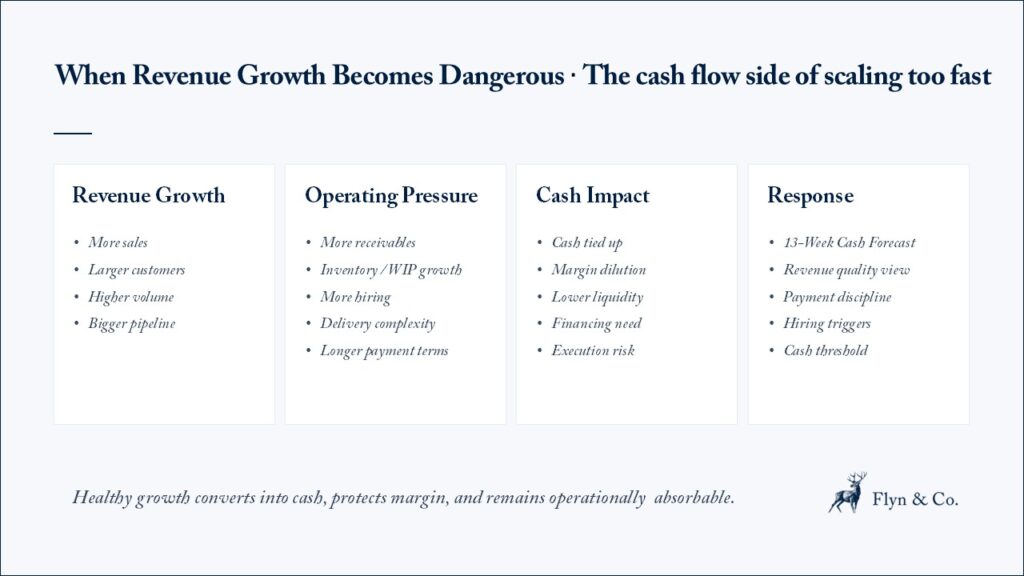
Growth consumes cash before it creates cash
Growth can make a business weaker before it makes it stronger
The most dangerous growth is not always obvious.
It often looks attractive at first:
- Sales are increasing : new clients or pricing-related ?
- The brand is gaining visibility
- Larger customers are entering the pipeline
- The team is expanding
- Suppliers are taking the company more seriously
- The founder feels the business is finally breaking through
But beneath that progress, cash can tighten.
The business may need to pay suppliers before customers pay invoices. It may need to hire ahead of revenue. It may need to carry more inventory. It may need to absorb longer payment terms from larger clients. It may need to fund onboarding, delivery, marketing, and systems before the new revenue turns into cash.
That is why fast growth can create a strange situation: the business is bigger, but less liquid.
The issue is the cash conversion of that growth.
Scaling revenue but not sure whether cash can keep up?
Flyn & Co. helps founders and SMEs build cash forecasts, revenue-quality views, and growth scenarios that make scaling decisions sharper, safer, and more finance-led.
The first danger: sales arrive before cash
A sale is not cash. This is the first principle of growth discipline.
Many founders mentally convert signed contracts, invoices, or pipeline into financial comfort too early. But the business can only pay salaries, suppliers, rent, taxes, and debt service with cash received — not revenue recognised.
That gap matters more as the business grows.
QuickBooks’ 2025 US Small Business Late Payments Report found that 56% of surveyed small businesses were owed money from unpaid invoices, with an average of 17.5 K USD owed per business, and 47% said part of their invoices were more than 30 days overdue. Late payment is not just an administrative inconvenience. It directly affects liquidity, hiring, financing needs, and investment capacity.
For a growing SME, this can become a scaling trap.
- The company sells more.
- It invoices more.
- It hires and delivers more.
- But collections lag.
The result is a business that appears to be growing but is actually financing its customers.
The second danger: working capital expands faster than expected
Growth often creates a working capital requirement.
That requirement may come from:
- Receivables
- Inventory
- Work in progress (WIP)
- Customer onboarding costs
- Supplier deposits
- Project delivery costs
- Payroll timing
- Tax timing
This is where many growth plans are too optimistic.
They forecast revenue growth and margin improvement, but they do not fully model the cash absorbed between selling and collecting.
For example, a company that grows monthly revenue from 100 K EUR to 180 K EUR may look stronger on the P&L. But if customers pay in 60 days and suppliers require payment in 30 days, the business may need to fund the gap. The higher the revenue, the larger the gap.
Growth amplifies working capital pressure.
As such, we ask ourselves : How much cash does each extra euro of revenue require before it becomes cash received?
The third danger: gross margin gets diluted
Fast growth can also hide margin deterioration.This happens when the business wins more work, but the new revenue is lower quality than expected.
For example:
- Larger customers negotiate lower prices
- Urgent delivery increases overtime or subcontracting costs
- Discounts are used to accelerate sales
- Product or service mix shifts toward lower-margin lines
- Operational errors increase as the team stretches
- Customer acquisition costs rise faster than revenue
Revenue increases, but gross margin weakens. This can be particularly dangerous because growth creates emotional cover. Leadership sees a stronger top line and assumes the business is improving, while the economics underneath are deteriorating.
A business can scale into lower profitability. And businesses use to accept this trade-off. That is why founders should track revenue quality.
The key questions are:
- Is new revenue higher or lower margin than the existing base?
- Does it improve or weaken cash conversion?
- Does it require more delivery effort?
- Does it create concentration risk?
- Does it increase complexity?
Revenue that adds volume but weakens margin, cash, and focus is not the same as healthy growth.
The fourth danger: fixed costs rise before the business is ready
Scaling often requires capacity.
That may mean hiring, software, office space, equipment, systems, marketing, management layers, finance support, or operational infrastructure.
Some of those investments are necessary. But they often come before the revenue is fully secured or converted into cash.
That creates a timing risk. The business commits to fixed costs based on expected growth. If growth is delayed, margin weakens, or collections slow down, the fixed cost base remains.
This is one of the classic ways a growing SME becomes financially fragile.
The founder hires for the business they expect to have in 6 months. But cash has to survive the next 6 weeks.
That means hiring should be linked to clear triggers:
- Revenue visibility
- Gross margin level
- Cash runway
- Pipeline conversion
- Delivery bottlenecks
- Customer service risk
- Minimum liquidity threshold
Scaling decisions should not be based only on ambition. They should be based on capacity the business can finance.
The fifth danger: larger customers can make cash flow worse
Larger customers often feel like progress. They bring credibility, bigger contracts, and potential repeat revenue.
But they can also bring:
- Longer payment terms
- More demanding procurement
- Heavier onboarding
- Customised requirements
- Lower pricing power
- More reporting
- Slower decision cycles
- Higher dependency
That can create an uncomfortable trade-off. The customer improves the revenue story but worsens the cash story.
This is especially important for SMEs selling to larger corporates. The deal may be commercially attractive, but the payment terms can turn the small business into a working capital provider.
The right question is : Can we afford to serve this customer under these terms?
Sometimes the answer is yes. Sometimes it is yes, but only with better payment milestones, deposits, shorter terms, or tighter scope control.
The sixth danger: management bandwidth becomes the hidden constraint
Cash is not the only constraint in fast growth. Management attention is another.
As revenue grows, the founder and leadership team must handle:
- More customers
- More people and resources
- More supplier issues
- More quality control
- Nore cash decisions
- More reporting needs
- <ore operational exceptions
If systems, roles, and management routines do not scale with revenue, the business becomes harder to control.
This matters because complexity often turns into cash pressure.
Poor delivery creates rework.
Weak billing discipline delays collections.
Unclear ownership slows decisions.
Overloaded teams make mistakes.
Bad handovers damage customer experience.
Founder dependency delays everything.
In other words, operational strain eventually becomes financial strain.
Fast growth is dangerous when the business outgrows its management system.
The seventh danger: cash buffers are often too thin
Many small businesses do not have much room for error.
JPMorgan Chase Institute research found that 50% of small businesses operate with fewer than 15 cash buffer days. Its broader research on small business cash flows also found that the median small business was effectively operating month to month, with enough cash to withstand only 27 days without inflows.
That matters because scaling increases the need for resilience.
A business with thin cash reserves may survive at a stable size but become vulnerable when it grows. Growth adds volatility: more invoices, more payroll, more delivery cost, more working capital, more timing differences.
If the cash buffer does not grow with the business, the company can become larger but less secure.
This is one of the least intuitive points in scaling:
A growing company may need more cash discipline than a stable one, not less.
How to know when revenue growth is becoming dangerous
The warning signs usually appear before the crisis.
They include:
- revenue is growing but cash is flat or falling
- receivables are rising faster than sales
- overdue invoices are increasing
- gross margin is declining
- working capital is absorbing more cash
- hiring is ahead of confirmed revenue
- suppliers are being stretched
- customer concentration is increasing
- the founder is approving too many exceptions
- the forecast depends on optimistic collections
- the business needs more short-term credit despite higher sales
One of these signs may be manageable.
Several together should trigger a deeper review.
The most important signal is this:
If revenue is increasing but liquidity is tightening, growth is no longer self-funding.
That does not mean growth should stop.
It means growth needs to be financed, slowed, redesigned, or made more profitable.
How founders can scale without losing cash control
The answer is not to avoid growth.
The answer is to manage growth as a financing decision, not only a commercial objective.
1. Forecast cash before committing to growth
Every growth plan should include a cash view.
Not just a P&L forecast.
Not just revenue targets.
A cash forecast.
The forecast should answer:
- When will customers pay?
- When must suppliers be paid?
- What additional payroll is required?
- What inventory or delivery cost is needed?
- How much cash is tied up in receivables?
- What happens if collections are delayed?
- What is the minimum cash balance?
A simple 13-week cash forecast can be more useful than a sophisticated annual growth plan when liquidity is tight.
2. Track revenue quality, not only revenue size
Management should separate revenue by quality.
Useful lenses include:
- recurring versus one-off
- high-margin versus low-margin
- fast-collecting versus slow-collecting
- simple delivery versus complex delivery
- strategic customers versus distracting customers
- scalable revenue versus founder-dependent revenue
The objective is to understand whether growth strengthens the business.
A company does not need all revenue to be perfect. But it should know which revenue is profitable, cash-generative, and strategically useful.
3. Link hiring to operating triggers
Hiring ahead of growth can be necessary.
But it should not be automatic.
Before adding fixed cost, management should define clear triggers:
- confirmed revenue threshold
- expected workload threshold
- minimum cash buffer
- gross margin stability
- forecasted utilization
- customer service risk
- founder bottleneck risk
This prevents the business from scaling cost faster than revenue quality.
4. Negotiate payment terms as part of the growth strategy
Payment terms are not only administrative.
They are strategic.
A business growing with weak payment terms may be giving away financing for free. That is especially true when serving larger customers.
Founders should consider:
- deposits
- milestone billing
- shorter payment terms
- upfront setup fees
- late payment follow-up routines
- credit checks for larger exposures
- tighter delivery-to-invoice discipline
Improving payment terms can sometimes create more value than winning an additional low-margin customer.
5. Protect gross margin during growth
Growth should not be allowed to quietly dilute margin.
Management should review:
- pricing discipline
- discounting
- cost-to-serve
- mix effects
- delivery efficiency
- subcontracting or overtime costs
- customer-specific profitability
If the company is growing but gross margin is falling, leadership should understand why quickly.
Sometimes the answer is acceptable.
Sometimes the business is buying growth at the wrong price.
6. Define a minimum cash threshold
A growing SME should know its minimum acceptable cash level.
That threshold should reflect:
- Payroll obligations
- Supplier commitments
- Debt service
- Tax timing
- Working capital volatility
- Seasonality
- Downside scenario
This threshold becomes a decision trigger.
If forecast cash falls below it, management should act:
- slow hiring
- defer discretionary spend
- accelerate collections
- renegotiate terms
- secure financing
- reduce low-quality growth
The threshold should be discussed before the business is under pressure, not after.
7. Review growth through a cash conversion lens
The leadership team should regularly ask:
- How much cash does this growth consume?
- How long before revenue becomes cash?
- What working capital does each customer or product line require?
- Is growth improving or weakening margins?
- Are we scaling capacity ahead of cash?
- What happens if collections slip by 15, 30, or 45 days?
These questions make growth more disciplined.
They also make management less vulnerable to the false comfort of top-line momentum.
Final thought
Revenue growth without cash discipline can become a problem disguised as success.
That is what makes scaling dangerous. The business can appear stronger while becoming more exposed. Sales rise, but receivables stretch. Customers grow, but margins weaken. Capacity expands, but fixed costs rise. Activity increases, but cash control deteriorates.
The solution is to measure and become more disciplined.
Founders and SME leaders should treat growth as a capital-allocation decision. Not every euro of revenue has the same quality. Not every customer deserves the same attention. Not every growth opportunity is worth the working capital it consumes.
The best growth does not only increase the top line. It strengthens the business underneath it.
One final word : Stay tuned for more insights on Finance, Investing, Real Estate & Startups.
More posts...
Preparing a Board for a Difficult Quarter
How to explain a performance miss and secure decisions while the business still has room to act.
SaaS Financial Planning: How to Turn ARR Growth Into Cash and Enterprise Value
SaaS Financial Planning: How to Turn ARR Growth Into Cash and Enterprise Value ARR growth tells you whether a SaaS company is getting bigger. It
Budget 2027: Build a Plan Your Business Can Actually Use
The strongest budgets make assumptions explicit, quantify the cash impact and define how management will respond.
Why Bordeaux Wine Estates Need a 24-Month Cash Model
Why Bordeaux Wine Estates Need a 24-Month Cash Model Bordeaux’s wine industry is adjusting to lower volumes, shifting consumption, weaker exports and structural vineyard contraction.
Fractional CFO vs. Full-time CFO: Which One Should an SME Choose?
Fractional CFO or full-time CFO? Learn which option makes more sense for SMEs, growing businesses, and founder-led companies that need financial leadership without overbuilding the finance function.
Bordeaux Neighborhoods for Property Investment: Which Signals Matter Most?
Learn how to assess Bordeaux neighborhoods for property investment using four key signals:
tenant demand, entry basis, capex risk, and exit depth. A practical framework for smarter real estate
decisions.