
The SME Reporting Pack: What Decision-Makers Should See Every Month
Many small and medium-sized businesses (SMEs, Startups) produce monthly reports. Financial Reports.
Fewer produce reporting packs that actually help management decide. That distinction matters.
A monthly reporting pack is valuable because it helps leaders answer the questions that shape the business:
- Are we on track?
- What changed?
- Where are margins moving? upwards or the opposite ?
- Is cash improving or tightening?
- Which risks require action?
- What decisions need to be made now?
If the reporting pack does not help answer those questions, it may still be accurate. But it is not decision-useful.
For SME leaders, the objective should be simple: every month, the reporting should convert financial and operating data into management clarity.
✅ Relevant data.
✅ Better decisions.
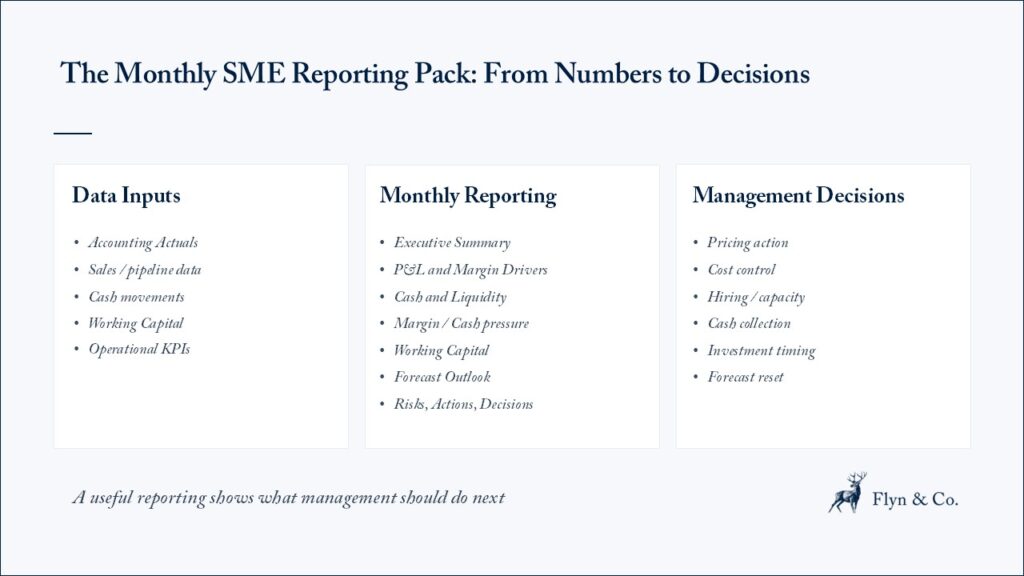
A useful reporting shows what management should do next
A reporting pack is not an accounting file
The first mistake is to confuse accounting output with management reporting.
Accounting tells the business what has happened, like a raw document. Management reporting should explain why it happened, what it means, and what should happen next. That difference is critical.
A trial balance, detailed P&L, aged receivables report, or payroll file may all be useful source documents. But they are not, by themselves, a management pack. They are inputs.
A decision-maker does not need every number every month. They need the right numbers, structured around the right questions.
That is why a strong SME reporting pack should be built from the top down:
- What decisions does management need to make?
- What indicators help inform those decisions?
- What analysis explains the movement?
- What actions follow?
The reporting pack should be a management tool.
The best SME reporting packs are short, focused, and repetitive
A good reporting pack does not necessarily need to be long. In fact, many reporting packs become weaker as they become longer. They contain too many tabs, too many metrics, too much historical detail, and too little interpretation.
For most SMEs, a strong monthly pack can be built in 8 to 12 pages. The purpose is to show what matters consistently.
That consistency is important. The structure should remain stable enough that leaders can quickly see what changed.
A useful reporting pack usually has 3 qualities:
1. It is recurring
The same core indicators appear each month. That creates rhythm and pattern recognition.
2. It is selective
Only decision-relevant metrics are included. Everything else stays in backup or simply not shown.
3. It is interpreted
The Reporting needs to tell a story, and provide explanations. Numbers are not left to speak for themselves. Variances, risks, and actions are clearly explained.
This is where many SME reports fail. They report the movement, but not always a meaning.
Turn Monthly Reporting into Better Business Decisions
Flyn & Co. helps SMEs structure monthly reporting around performance, cash, forecast accuracy, and decision priorities.
The Executive Summary
The first page is the most important page in the pack. It should answer one question:
What does management need to know this month?
A strong executive summary should include:
- Revenue performance
- Gross margin movement
- EBITDA or operating profit trend
- Cash position
- Working capital pressure
- Forecast outlook
- Key Opportunities & Risks
- Decisions required
This page should be a synthesis with story.
For example :
|
Area |
Message |
|---|---|
| Revenue | Ahead of plan, but concentrated in two customers (a risk…). |
| Margin | Gross margin down due to mix and supplier cost pressure |
| Cash | Closing cash stable, but receivables overdue are increasing |
| Forecast | Full-year revenue still achievable, margin risk emerging |
| Decision needed | Approve pricing action or cost mitigation plan |
This type of summary helps leaders move quickly from reporting to decision-making.
The best executive summaries are direct. They do not hide behind neutral language.
- If margin is deteriorating, say it.
- If cash risk is building, mention it.
- If the forecast depends on one customer or one project : the Reporting needs to say it.
The reporting pack should reduce ambiguity.
P&L performance — but with drivers
Every SME reporting pack needs a P&L view. But the P&L should go beyond actuals versus budget. That would be too limited.
A decision-useful P&L page should explain performance through drivers:
- Revenue volume
- Pricing
- Mix
- Gross margin
- Payroll and Personnel Expenses
- Operating expenses
- EBITDA or operating result
The key questions are : Why are we above or below budget? Why are we above or below previous year ?
For example, revenue may be ahead of plan, but only because low-margin work increased. Or revenue may be below budget, but margin may be stronger because the business avoided unprofitable sales.
Those are very different situations.
A strong P&L page should therefore include:
- Monthly actuals
- Year-to-date (YTD) actuals
- Budget or forecast comparison
- Variance in value and percentage
- Short explanation of the top three movements
- Margin bridge where relevant
The analysis should focus on the key drivers that moved the result.
Revenue quality
Many SMEs track revenue but not revenue quality and its nature. Not all revenue is equal.
Some revenue is recurring. Some is one-off. Some is high-margin or some come from one customer / client. Some consumes too much operational capacity. Some improves cash. Some creates working capital pressure. Some strengthens the business. Some makes it more fragile.
A good reporting pack should show revenue through a management lens.
Depending on the business and maturity, this may include:
- Recurring versus non-recurring revenue
- Revenue by customer segment or Business line
- Revenue by product or service line
- Average order value
- Volume, price, and mix
- Customer concentration
- Churn or retention
- Pipeline conversion
The objective is to help management understand whether growth is healthy. A company can grow revenue and still weaken performance if the growth is low-margin, cash-consuming, or operationally complex.
That is why revenue quality deserves its own page.
Gross margin and levels of profitability
Gross margin is one of the most important indicators in an SME. It often reveals whether the business model is strengthening or weakening before the full P&L does.
A good margin page should show :
- Gross margin percentage
- Gross margin value
- Margin by product, service line (or Business Unit), or customer segment
- Margin movement versus prior month and budget
- Key causes of margin change
- Pricing or cost actions required
The analysis should separate structural margin issues from temporary effects.
Some examples :
- Was margin lower because of a one-off project?
- Was it lower because supplier costs increased?
- Was it lower because pricing discipline weakened?
- Was it lower because the mix shifted toward lower-value work?
- Was it lower because operational inefficiency increased?
These are different problems requiring different actions. A margin page should help management identify where to intervene.
Cash and liquidity
For Small Companies (and for every company), cash deserves a page of its own. Profitability matters, but liquidity determines room to manoeuvre.
A monthly cash page should show:
- Opening cash
- Cash inflows
- Cash outflows
- Closing cash
- Net cash movement
- Short-term cash outlook
- Debt service or financing commitments
- Minimum cash threshold
- Liquidity headroom
This is especially important because a business can be profitable and still experience cash pressure.
The reporting pack should make that visible.
A useful cash page should answer:
- Did cash improve or deteriorate?
- Was the movement expected?
- What drove the movement?
- Are there upcoming cash pressure points?
- Does management need to delay spend, accelerate collections, or secure financing?
For businesses with tighter liquidity, the monthly pack should also connect to a 13-week cash forecast.
The monthly pack shows the management picture.
The 13-week forecast shows the liquidity runway.
Both are useful, but they serve different purposes.
To find more about Cash Flow Forecasting in Small Businesses:
Working capital
Working capital is often where SME cash gets trapped. A business may appear commercially strong while cash is quietly absorbed by receivables, stock, work in progress, or supplier timing.
A good reporting pack should therefore include a working capital page.
At minimum, this should show:
- Accounts receivable
- Overdue receivables
- DSO
- Accounts payable
- Inventory or work in progress, where relevant
- Customer deposits or deferred revenue, where relevant
- Working capital movement versus prior month
The focus should be practical.
- Which customers are late?
- Which invoices need escalation?
- Is stock building faster than sales?
- Are supplier payments creating hidden pressure?
- Is working capital improving because of discipline or because the business is delaying payments unsustainably?
This page should trigger actions, more than simply observations.
For many SMEs, better working capital management is one of the fastest ways to release cash without raising prices, cutting staff, or taking on debt.
Cost base and operating leverage
Cost reporting is often too detailed and not analytical enough. Decision-makers do not need to review every expense line each month. They need to understand how the cost base is behaving.
A useful cost page should separate:
- Fixed costs
- Variable costs
- Discretionary costs
- People related costs
- One-off costs
- Investment-type costs
This distinction matters. A cost increase may be acceptable if it supports future revenue, improves delivery, or removes operational bottlenecks. But a cost increase that adds complexity without improving performance should be challenged.
The reporting pack should also show operating leverage. In simple terms: Is the business becoming more efficient as it grows?
If revenue increases but costs rise just as fast, the business may be growing without scaling. If costs are fixed but revenue is not growing, the business may be carrying too much structure.
A cost page should therefore help management distinguish between:
- Necessary investment
- Cost drift
- Underused capacity
- Structural inefficiency
- Short-term variance
That is more useful than simply showing that costs are above or below budget.
Forecast outlook
Decision-makers need to know what is now likely to happen. That means every monthly reporting pack should include a forecast view.
This does not need to be overly complex. But it should show:
- Latest full-year (FY) forecast
- Comparison to budget / previous year
- Comparison to prior forecast
- Key changes since last month
- Forecast risks
- Forecast opportunities
- Management actions required
This page is critical because actuals are already history.
The forecast turns the pack into a decision tool.
For example, if year-to-date performance is behind budget but the latest forecast shows recovery, management needs to understand why. If year-to-date performance is ahead but the forecast is weakening, management needs to act before the issue becomes visible in reported results.
The best forecast page answers: What do we now believe will happen, and what should we do about it?
KPI dashboard
A KPI dashboard should be selective.
Many SME dashboards include too many indicators because every function wants visibility. The result is usually a page that looks complete but does not guide decisions.
A useful KPI dashboard should include only the metrics that management genuinely uses.
For many SMEs, this means 5 to 10 core KPIs across:
- Growth
- Margin
- Cash
- Customer activity
- Delivery or operations
- People or capacity
The dashboard should also show movement:
- Current month
- Prior month
- Target
- Trend
- Key colours : Red / Amber / Green (or Blue)
- Owner (Business Unit)
Here, the key is ownership. A KPI without an owner is just a number.
If the dashboard shows deteriorating receivables, someone should own the action. If gross margin is falling, someone should explain the cause and response. If customer churn is rising, someone should lead the corrective plan.
The dashboard should not only measure performance. It should create accountability.
Risks, Opportunities, actions, and decisions required
This is the page many SME reporting packs are missing. A reporting pack should end with management action.
The final page should show:
- Key risks
- Key Opportunities
- Decisions required
- Proposed actions
- Owner
- Deadline
- Expected impact
- Status from prior month
This creates continuity between reporting cycles. For example:
| Issue | Decision / Action | Owner | Deadline | Expected impact |
|---|---|---|---|---|
| Overdue receivables increasing | Escalate top 5 overdue customers | Finance / Sales | 7 days | Improve short-term cash |
| Gross margin below target | Review pricing on low-margin accounts | CEO / Sales | Month-end | Protect margin |
| Hiring plan ahead of revenue | Pause non-critical recruitment | CEO | Immediate | Preserve cash |
| Forecast risk in Q4 | Prepare downside cost scenario | Finance | Next review | Improve visibility |
This final page is where reporting becomes management.
Without it, the pack may describe the business well, but fail to change behaviour.
The financial reporting pack should evolve with the business
An SME reporting pack should not be static forever. As the business grows, the pack should evolve, it should adapt.
An early-stage company may need more focus on cash, pipeline, and runway. A profitable services business may need more focus on utilization, margin, and receivables. A product business may need deeper visibility on stock, gross margin, and working capital. A company preparing for financing or a sale may need more structured KPIs, forecast reliability, and value drivers.
The reporting pack should reflect the business model.
But it should always preserve the same core logic:
- What happened?
- Why did it happen?
- What is likely to happen next?
- What decisions are required?
That logic does not change.
Final thought
The best SME reporting pack is the one that helps decision-makers see the business more clearly.
A good pack should connect financial performance, cash movement, operating drivers, forecast outlook, and management actions. It should highlight what matters, explain what changed, and make decisions easier.
That is the real purpose of reporting : to improve management and management decisions.
In a small business (including startups), every month matters. The reporting pack should make each month easier to understand, easier to manage, and easier to act on.
Need a clearer monthly reporting rhythm? Explore our financial planning and analysis support for management reporting, forecasting and decision support.
One final word: Stay tuned for more insights on Finance, Investing, Real Estate & Startups.
More posts...
Preparing a Board for a Difficult Quarter
How to explain a performance miss and secure decisions while the business still has room to act.
SaaS Financial Planning: How to Turn ARR Growth Into Cash and Enterprise Value
SaaS Financial Planning: How to Turn ARR Growth Into Cash and Enterprise Value ARR growth tells you whether a SaaS company is getting bigger. It
Budget 2027: Build a Plan Your Business Can Actually Use
The strongest budgets make assumptions explicit, quantify the cash impact and define how management will respond.
Why Bordeaux Wine Estates Need a 24-Month Cash Model
Why Bordeaux Wine Estates Need a 24-Month Cash Model Bordeaux’s wine industry is adjusting to lower volumes, shifting consumption, weaker exports and structural vineyard contraction.
Fractional CFO vs. Full-time CFO: Which One Should an SME Choose?
Fractional CFO or full-time CFO? Learn which option makes more sense for SMEs, growing businesses, and founder-led companies that need financial leadership without overbuilding the finance function.
Bordeaux Neighborhoods for Property Investment: Which Signals Matter Most?
Learn how to assess Bordeaux neighborhoods for property investment using four key signals:
tenant demand, entry basis, capex risk, and exit depth. A practical framework for smarter real estate
decisions.