
5 Decision-Making Frameworks Founders and SME Leaders Can Actually Use
Frameworks often get a bad reputation.
In large companies, they can become theatre. In consulting decks, they can become overdesigned. In small businesses, they can feel too corporate for the pace of reality.
But that is not what a useful framework is.
A useful decision-making framework is simply a repeatable way to think clearly when the business is under pressure. It does not replace judgment. It improves it.
For founders and SME leaders, that matters because many decisions have to be made with imperfect information, limited cash, and very real consequences. A weak decision rarely stays theoretical for long. It shows up quickly in margin, cash, team energy, customer experience, or execution complexity.
The best frameworks are not the most sophisticated ones. They are the ones a leadership team can actually use.
The goal is to make better decisions without slowing the business down.
Why founders need practical decision-making frameworks
Small businesses often make decisions through proximity.
The founder knows the customer. The founder knows the product. The founder knows the cash position. The founder knows the team.
That proximity is powerful. It creates speed, instinct, and commercial energy.
But it can also create blind spots.
As the business grows, the cost of poor decisions rises. More people depend on the outcome. More cash is committed. More decisions become harder to reverse. A choice that once affected only the founder can now affect the whole operating model.
That is why frameworks help.
They make the logic visible. They force trade-offs into the open. They reduce emotional noise. They make it easier to compare options. They help the team understand why a decision was made.
The goal is not to turn a founder into a corporate committee. The goal is to make better decisions without slowing the business down.
Framework 1: Objective, Options, Trade-offs
This is the simplest and often the most useful framework.
It works because many weak decisions start before the analysis begins. The team has not clearly agreed on the objective. The options are incomplete. The trade-offs are implicit.
This framework fixes that.
Step 1: Clarify the objective
Start with one question: What are we trying to achieve?
Not vaguely. Specifically. For example: improve cash visibility, protect gross margin, accelerate qualified pipeline, reduce founder dependency, enter a new customer segment, improve delivery capacity, or simplify the operating model.
A decision without a clear objective tends to drift toward the loudest voice, the most recent problem, or the easiest action.
For example, “Should we hire a salesperson?” is not precise enough. A better version would be: Should we hire a salesperson in Q3 to increase qualified pipeline in our highest-margin segment, while keeping fixed costs within our current cash runway? Now the decision has shape. The objective, timing, financial constraint, and commercial logic are all clearer.
Step 2: List the real options
Many teams compare one preferred option against “do nothing.” That is usually weak decision-making. A better approach is to define three or four real options.
If the issue is growth, the options might be: hire internally, use an external partner, improve current channels before adding capacity, or test one segment before scaling. If the issue is a weak product line, the options might be: invest and reposition it, simplify and retain it, sell or close it, or keep it temporarily with clear performance thresholds.
The goal is to avoid false choices, not create endless alternatives.
Step 3: Name the trade-offs
Each option should be tested against what it gives and what it takes: growth versus profitability, speed versus control, simplicity versus upside, short-term cash versus long-term value, customer satisfaction versus operational complexity.
A decision improves when the team stops pretending one option has only benefits. Every serious business decision contains a cost. The question is whether the business is willing to pay it.
When to use this framework
Use it when the team is debating vaguely, the objective is unclear, several options seem plausible, people are arguing from different priorities, or the decision has strategic consequences.
This framework prevents decisions based on habit, emotion, or one-dimensional logic. It forces the leadership team to say: this is what we are optimising for, these are the real choices, and this is the trade-off we are accepting.
Framework 2: Impact, Effort, Reversibility
This framework is useful when a business has too many initiatives and not enough capacity. That is common in SMEs.
Founders often have more ideas than the organisation can absorb: new campaigns, new products, new hires, new tools, new geographies, new partnerships, new reporting processes. Each one may sound reasonable in isolation. Together, they create overload.
The framework asks three questions: Impact (if this works, how much does it matter?), Effort (what will it absorb?), and Reversibility (how easy is it to undo?).
Impact
Impact should be assessed in terms of real business value, not excitement. A high-impact initiative should move something important: revenue quality, gross margin, cash generation, customer retention, operating leverage, strategic positioning, or enterprise value.
The key question is: if this works, will it materially change the business? If the answer is no, the initiative may still be useful, but it should not consume disproportionate management attention.
Effort
Effort is not only financial cost. It includes founder attention, management time, team coordination, implementation complexity, operational disruption, learning curve, and systems impact.
Small businesses often underestimate effort because they only look at external spend. But management bandwidth is also a cost. In many SMEs, it is the scarcest resource.
Reversibility
Some decisions can be tested and reversed quickly. Others create long-term commitments. A marketing test may be reversible. A pricing experiment may be partially reversible. A senior hire is harder to reverse. A long-term lease is difficult to reverse. A market entry can create commitments beyond the first investment.
Reversibility should influence decision speed. A high-impact, low-effort, reversible decision can move quickly. A high-impact, high-effort, hard-to-reverse decision deserves more scrutiny.
When to use this framework
Use it when there are too many initiatives, prioritisation feels political, the team is overloaded, management attention is stretched, or the business needs to decide what not to do.
This framework prevents initiative inflation. It helps founders stop treating every good idea as an immediate priority. In small businesses, focus is often the real constraint. This framework protects it.
Framework 3: Base Case, Downside, Upside
Base case
The base case is what management currently believes is most likely. It should not be overly optimistic. It should reflect the most realistic view based on current information: expected sales conversion, expected collection timing, expected gross margin, expected hiring timeline, expected customer response, expected implementation cost. The base case should be credible enough that the team would still believe it after being challenged.Downside case
The downside case asks: what happens if the key assumptions move against us? This is not pessimism. It is resilience testing. For example: sales take longer than expected, a customer pays late, recruitment is delayed, costs rise, churn increases, implementation takes longer, or gross margin is weaker than expected. The most important question is: can the business live with the downside? If the answer is no, the decision may still be possible, but it needs mitigation — staging the investment, reducing fixed commitments, delaying hiring, renegotiating terms, or defining a stop-loss point.Upside case
The upside case asks what happens if the decision works better than expected. This is often ignored, but it matters. Upside can also create pressure: more working capital required, more hiring needed, more operational strain, more customer support, faster system limitations, and quality-control risk. Good news can still create execution risk. A business that is not ready for success can damage customer experience, team capacity, or cash discipline.When to use this framework
Use it for hiring decisions, capex, borrowing, expansion, pricing changes, new product launches, or major commercial initiatives. This framework prevents single-scenario optimism. It forces management to test whether the business is making a decision it can survive, not only one it would like to succeed. That distinction matters.Framework 4: Build, Buy, or Partner
This is one of the most useful strategic frameworks for SMEs.
When a business identifies a capability gap, the instinct is often to build internally. But that is only one option. The real question is: should we build, buy, or partner?
Build
Building means creating the capability internally. This may be the right choice when the capability is strategically core, control matters, the business can afford the learning curve, the capability will be reused often, or differentiation depends on owning it.
For example, a company may decide to build internal FP&A capability if financial visibility is central to future growth and investor readiness. The risk is that building can take longer and cost more than expected. The hidden cost is usually not the salary or the tool — it is the time required to define, manage, and mature the capability.
Buy
Buying can mean acquiring software, hiring a specialist, purchasing a company, or paying for an external solution. This may be the right choice when speed matters, the capability already exists elsewhere, the internal learning curve is too costly, the business needs a proven solution, or the economics are better than building.
For example, an SME may buy a software tool, hire a specialist consultant, or recruit a senior profile to accelerate a capability that would take too long to develop internally. The risk is poor fit — a business can buy a solution and still fail to integrate it properly.
Partner
Partnering means working with another company, expert, platform, or provider to access a capability without owning it fully. This may be the right choice when flexibility matters, the business wants to test before committing, internal ownership is not necessary, the partner has strong expertise, or the cost of building is not justified.
For example, a founder may partner with an external finance or strategy advisor before committing to a full-time CFO or internal strategy role. The risk is lower control and potential misalignment over time.
The core trade-off
This framework usually comes down to four variables: speed, control, cost, and strategic importance. If the capability is highly strategic and recurring, building may make sense. If speed matters and the capability is available externally, buying may be better. If the need is uncertain or temporary, partnering may be the smartest first step.
When to use this framework
Use it for decisions involving technology, marketing, sales channels, operations, logistics, finance support, geographic expansion, or specialist expertise.
This framework prevents default thinking. Some founders overbuild because internal ownership feels safer. Others outsource too quickly because it feels cheaper. The framework helps clarify which choice fits the strategic and economic reality.
Framework 5: Value, Cash, and Complexity
This is one of the most practical filters for small businesses.
Before approving a project or initiative, ask three questions: Does this create value? What does it do to cash? How much complexity does it add?
Does this create value?
Not activity. Not visibility. Not excitement. Value. That could mean: higher margin, stronger retention, better customer quality, reduced risk, improved cash generation, higher enterprise value, or stronger operating leverage.
If the value logic is unclear, the initiative should be challenged. A project may be interesting and still not be valuable enough to deserve priority.
What does it do to cash?
A decision can look strategically attractive and still create near-term cash pressure. This is common in SMEs. Hiring may support growth but increase fixed costs. Inventory may unlock sales but consume cash. Renovation may improve asset value but create a funding gap. Marketing may build pipeline but delay payback. A large customer may increase revenue but stretch working capital.
Cash impact does not automatically make the decision bad. But it must be visible. A decision that improves long-term value can still be poorly timed if it puts too much pressure on liquidity.
How much complexity does it add?
Complexity is one of the most underestimated costs in small businesses. A new initiative can add: coordination burden, operational exceptions, reporting needs, team confusion, customer support pressure, management distraction, and process fragility.
This matters because complexity can quietly consume the benefits of growth. A business can become bigger and weaker at the same time if complexity grows faster than capability. That is why many founders should ask not only “Can we do this?” but also: can we absorb this?
When to use this framework
Use it before launching a new offer, accepting a complex customer, entering a new market, adding a new tool, hiring into a new role, expanding operations, or approving a major project.
This framework prevents attractive ideas from bypassing economic reality. It forces the team to ask: does this create enough value to justify the cash and complexity it consumes? That is one of the best questions an SME can ask.
How to choose the right framework
Not every decision needs every framework. The right tool depends on the decision.
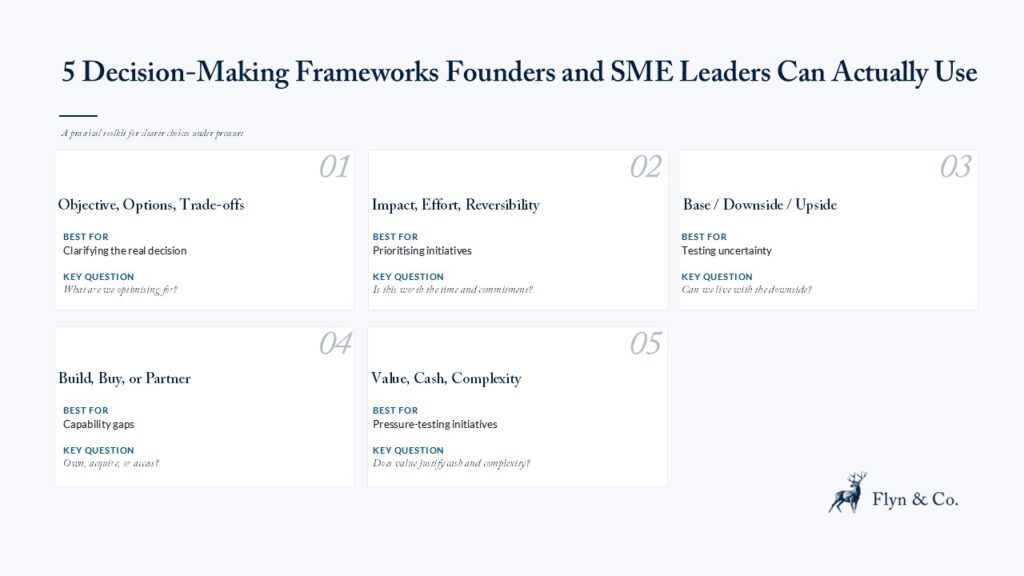
When the objective is unclear, use Objective, Options, Trade-offs. When there are too many initiatives, use Impact, Effort, Reversibility. When the outcome is uncertain, use Base Case, Downside, Upside. When the business needs a new capability, use Build, Buy, or Partner. When a project looks attractive but may add cash or operational pressure, use Value, Cash, and Complexity.
The purpose is not to create process. The purpose is to improve judgment.
How to use frameworks without slowing the business down
The most practical approach is to keep the framework lightweight. For most SME decisions, one page is enough.
A useful decision note can include: decision to be made, objective, options, key trade-offs, cash impact, complexity impact, downside risk, recommendation, owner, and review trigger.
This should not become a large document. It should become a better conversation. A framework is working when the team makes a clearer decision faster than before.
Final thought
Decision-making frameworks are not valuable because they make founders think like large corporations. They are valuable because they help founders protect scarce resources: time, cash, focus, team energy, and execution capacity.
The best framework is not the most sophisticated one. It is the one the business can actually use when the decision is uncomfortable, expensive, or hard to reverse.
That is when structure matters most. Because in small businesses, weak decisions do not stay theoretical for long. They show up quickly in cash, margin, complexity, and execution.
One final word : Stay tuned for more insights on Finance, Investing, Real Estate & Startups.
Need a financial model that makes trade-offs clearer?
When a decision involves funding, investment or competing scenarios, a robust financial model makes the trade-offs visible. Founders preparing a business plan, funding case or investor discussion can also explore our Startup Founder Advisory.
Explore Financial ModelingMore posts...
SaaS Financial Planning: How to Turn ARR Growth Into Cash and Enterprise Value
SaaS Financial Planning: How to Turn ARR Growth Into Cash and Enterprise Value ARR growth tells you whether a SaaS company is getting bigger. It
Budget 2027: Build a Plan Your Business Can Actually Use
The strongest budgets make assumptions explicit, quantify the cash impact and define how management will respond.
Why Bordeaux Wine Estates Need a 24-Month Cash Model
Why Bordeaux Wine Estates Need a 24-Month Cash Model Bordeaux’s wine industry is adjusting to lower volumes, shifting consumption, weaker exports and structural vineyard contraction.
Fractional CFO vs. Full-time CFO: Which One Should an SME Choose?
Fractional CFO or full-time CFO? Learn which option makes more sense for SMEs, growing businesses, and founder-led companies that need financial leadership without overbuilding the finance function.
Bordeaux Neighborhoods for Property Investment: Which Signals Matter Most?
Learn how to assess Bordeaux neighborhoods for property investment using four key signals:
tenant demand, entry basis, capex risk, and exit depth. A practical framework for smarter real estate
decisions.
When Revenue Growth Becomes Dangerous: The Cash Flow Side of Scaling Too Fast
In small businesses, growth can consume cash faster than it creates it. The danger is not growth itself, but growth that stretches working capital, weakens margins, increases fixed costs, and hides liquidity risk behind a positive sales story.